7 Untapped Procurement Metrics That Reveal Hidden Value

The hidden scores that tell you more than the usual ones. Every company has a team that buys the things it needs: materials, machines and services. This team is called procurement.
Like any shopper, they keep score:
Did we save money? Did the orders arrive on time?
These basic metrics matter but they only tell part of the story.
There is a second set of numbers that most companies still do not watch even though they often point to bigger problems and bigger savings.
Here are seven of them explained simply.
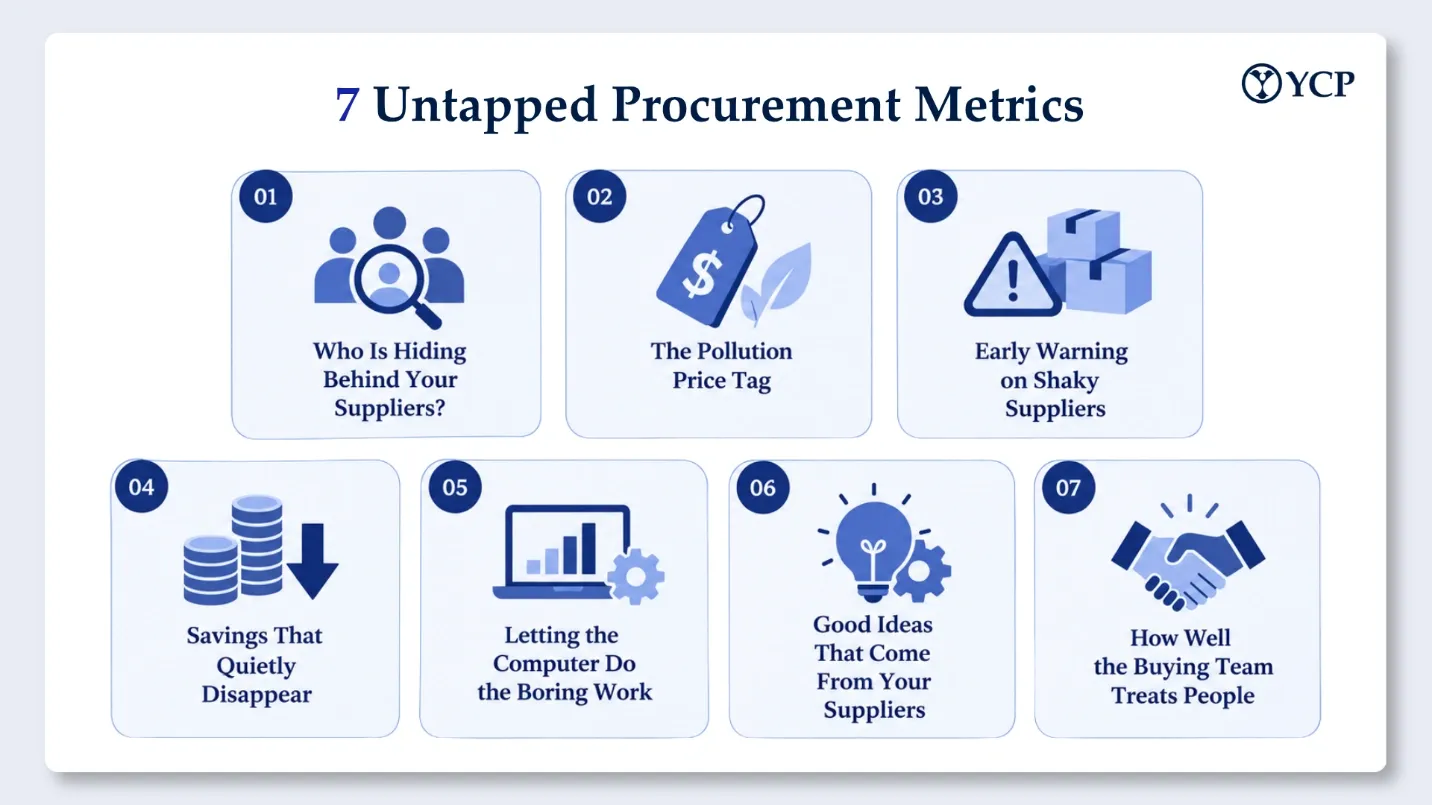
1. Who Is Hiding Behind Your Suppliers?
You know the company you buy from. But do you know who they buy from?
Picture a bakery that gets flour from one shop and that shop gets its wheat from a single farm.
If that farm fails the bakery is stuck even though it never dealt with the farm directly.
Most companies never look this far back. They only find out when something breaks.
The metric: How much visibility do you have beyond your direct suppliers?
Understanding the deeper layers of your supply base can reveal hidden dependencies before they become disruptions.
2. The Pollution Price Tag
New rules are starting to charge companies for the pollution their products cause.
Most firms simply tick a box saying a supplier is “green.”
The smarter approach adds the pollution cost to the price when choosing a supplier.
A cheaper option that pollutes more may not actually be cheaper once the full bill is counted.
The metric: What is the true cost of a supplier when environmental impact is included?
This shifts sustainability from a compliance exercise into a factor that directly influences sourcing decisions.
3. Early Warning on Shaky Suppliers
Anyone can say, “Our supplier went out of business.”
The useful question is:
How many days did we see it coming?
If you spot trouble months ahead you can line up a backup.
If you find out the day the delivery fails to arrive you are in trouble.
Very few companies measure how much warning they actually get.
The metric: How much lead time do you have between identifying supplier risk and experiencing disruption?
The earlier the warning the more options procurement has to respond.
4. Savings That Quietly Disappear
Say the buying team announces it saved a lot of money on a deal.
A year later only part of that saving has actually shown up because people bought outside the deal, ordered less than promised or prices slowly crept back up.
The honest number is how much of the promised saving actually stayed.
It is usually far less than announced and almost nobody checks.
The metric: How much of the savings you announced was actually realised and sustained?
Savings should not be measured only when a contract is signed. They should be tracked through to actual business impact.
5. Letting the Computer Do the Boring Work
A lot of the paperwork in buying can now be handled by software and AI.
The number worth watching is not just how many forms are automated.
It is how much of the real buying work runs with little human effort while freeing people to spend their time on smarter and more valuable decisions.
The metric: What percentage of procurement activity can run with minimal human intervention?
The goal of automation is not simply to automate paperwork. It is to give procurement professionals more time to focus on decisions that create value.
6. Good Ideas That Come From Your Suppliers
Your suppliers often know how to cut costs or improve a product better than you do.
So the question is:
How many of your improvements actually came from supplier ideas?
Most companies never count this.
Which means they never reward the suppliers who help them the most.
The metric: How much measurable value comes from supplier-led innovation?
Tracking supplier-generated ideas can reveal which relationships are creating value beyond the negotiated contract.
7. How Well the Buying Team Treats People
This one is ignored almost everywhere and it may be the most important.
Buying is not only about price. It is about people.
Procurement staff deal with suppliers, colleagues and bosses every single day. Yet many of them even at the most senior levels come across as blunt, dismissive or poor at listening.
That quietly does real damage.
Suppliers become less willing to go the extra mile and other departments start avoiding the buying team altogether.
The number to watch is simple:
Ask suppliers and internal colleagues how respectful, clear and easy to deal with the team is.
A team that scores well earns better cooperation, better prices and better ideas for one plain reason:
People want to work with those who treat them well.
What Ties Them Together?
All seven have one thing in common.
Until recently they were simply too hard to measure or easy to ignore.
Now thanks to better data, new rules, smarter software and a growing understanding that behaviour matters as much as price they can finally be tracked.
And hardly anyone is doing it yet.
A company that starts watching even two or three of these metrics can spot problems earlier and find value that others miss completely.
The biggest opportunity may not be in measuring more.
It may be in measuring what everyone else is overlooking.
Get in Touch with Us
Get in touch with us to discuss your strategic needs and how we can help you develop a plan to accelerate your growth
Schedule a ConsultationRelated Articles

Procurement Transformation: From Cost to Strategic Value
Industrials
Why Process Mapping Is the Foundation of Procurement Excellence
Industrials
Is Your Material Data Quietly Costing You Millions?
Industrials