Is Your Material Data Quietly Costing You Millions?
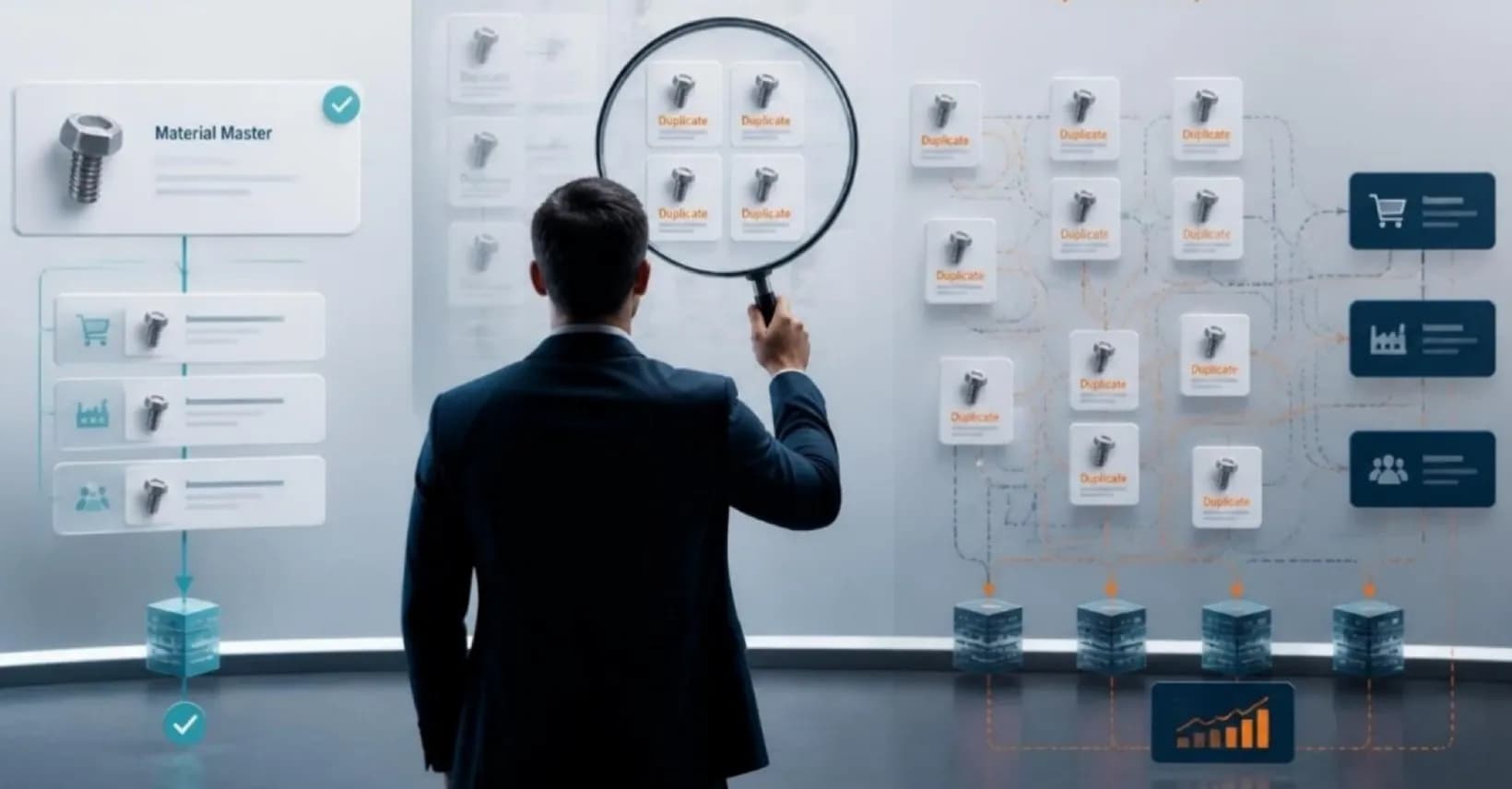
Most procurement and finance leaders already suspect their material master has duplicates: the same part listed under different names or codes and scattered across sites, systems or years of legacy data migrations.
What almost nobody expects is that this is not just a data-quality footnote.
It is actively costing real money in two separate places at the same time. And cleaning it up only solves part of the problem.
The Duplicate You Didn’t Know You Had
Material master duplication rarely happens on purpose.
A part gets entered under a slightly different name at one site, a different abbreviation at another or a new code gets created because nobody could find the existing one quickly enough.
Over years and across multiple sites or business units, this compounds.
And it doesn’t stop happening just because a system migration is long finished.
In many organizations, duplicate codes continue to be created today, not just inherited from the past, simply because the controls that would catch them at the point of entry are weaker than anyone realizes.
The result is a material master that looks far larger and more fragmented than the business it is actually describing.
Two Hidden Costs Hiding in Plain Sight
Once duplication exists, it doesn’t just clutter a database.
It quietly drains value in two specific and traceable ways.
Cost #1: Money Sitting on a Shelf
If the same part exists under two codes, a company can end up holding physical stock against both.
That inventory may look fully justified on paper but is actually a duplicate of stock that already exists elsewhere in the system.
The result is excess inventory that ties up working capital without adding value.
Cost #2: Paying Two Different Prices for the Same Thing
When the same item gets purchased under different codes, sometimes by different teams or through different buying channels, it is entirely possible to pay two different prices for an identical part.
And nobody may notice because nothing in the system flags them as the same item.
Neither of these costs shows up as a single alarming transaction.
They accumulate quietly, one small gap at a time, until someone actually lines the data up and looks.
How the Analysis Actually Works
The first step is finding duplicates with real confidence rather than guesswork.
AI-based clustering compares material attributes and groups likely-equivalent items into confidence tiers, from near-certain matches to items that simply warrant a closer look.
This matters because not every duplicate deserves the same urgency.
A handful of high-confidence high-impact duplicates can be cleaned up immediately while broader lower-confidence clusters need validation first.
Step 1: Trace the Inventory Impact
Every confirmed duplicate cluster is traced into two areas.
On the inventory side, the question is simple:
How much physical stock is sitting there specifically because of this duplication?
This connects the data-quality issue directly to its financial impact.
Step 2: Trace the Procurement Impact
On the procurement side, the question is:
Across every recorded purchase within this cluster, how much extra was paid compared with the lowest price already achieved for the exact same item?
That second calculation is deliberately conservative.
It only counts confirmed duplicate clusters with verified purchase history. The resulting number is therefore a genuine floor rather than an inflated estimate.
The Bigger Surprise: What’s Beyond the Duplicates
Here’s the part that consistently surprises people:
Cleaning up duplicates is usually the smaller opportunity, not the larger one.
Once the duplicate-linked findings are isolated, the same level of rigour is applied a second time to the entire inventory base and the full multi-year procurement dataset.
This second analysis is completely independent of whether an item is a duplicate.
It typically surfaces a materially larger opportunity, including:
Inventory sitting outside any clear stocking policy
Procurement spend that bypassed existing supplier agreements
Purchasing patterns fragmented across too many vendors
Lost negotiating leverage caused by fragmented spend and supplier relationships
Critically, these two findings, the duplicate-linked track and the broader independent track, are not blended into one impressive-sounding total.
They are kept deliberately separate because they come from genuinely different evidence.
Combining them without care risks double-counting the same dollar twice.
A number that cannot survive someone asking “Where exactly did that come from?” isn’t worth presenting in the first place.
Why This Matters for Procurement and Finance Leaders
This isn’t about proving that duplicate data is bad. Everyone already assumes that.
It’s about knowing precisely:
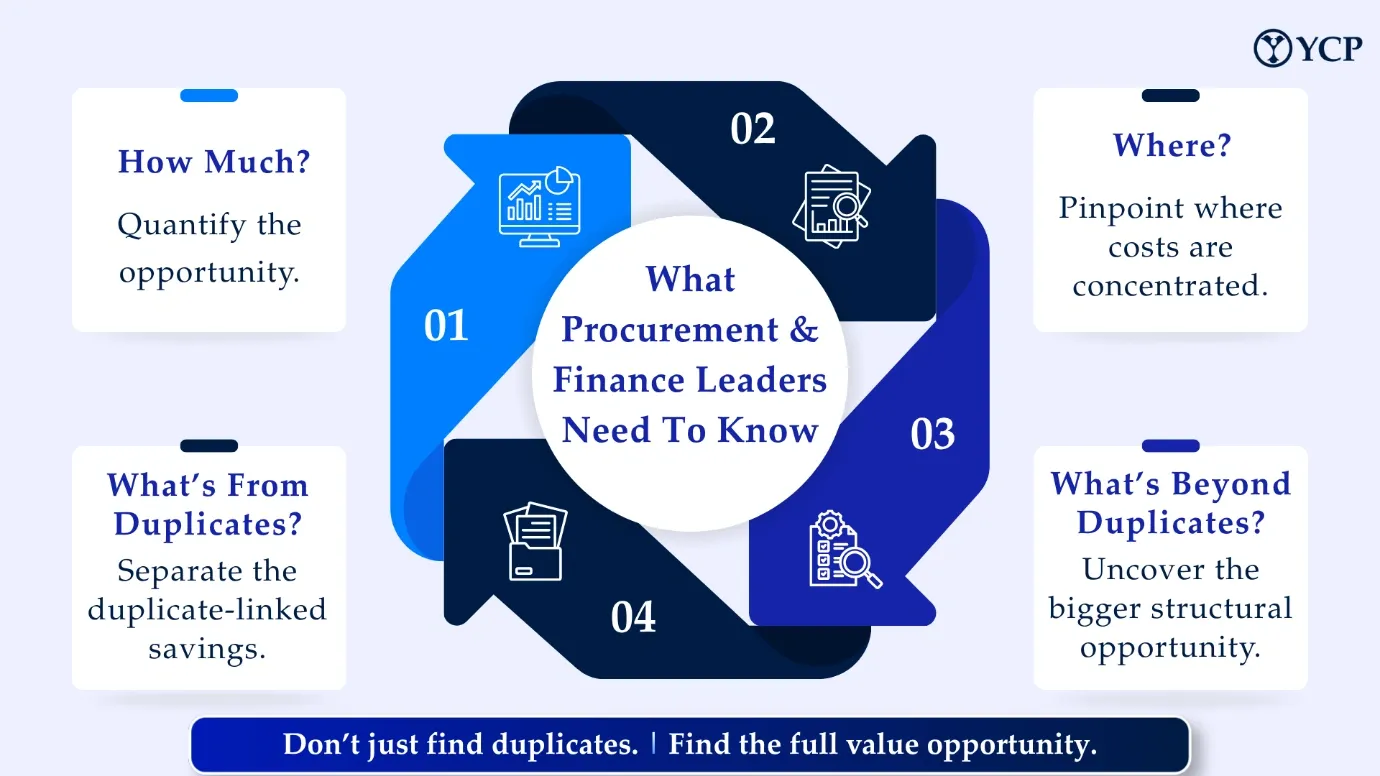
How much it costs
Where the cost is concentrated
What portion of the opportunity is directly linked to duplication
What larger opportunities exist across the broader data set
Organizations that stop at “Let’s clean up the master data” often walk away having solved the smaller problem while missing the bigger one entirely.
The two tracks, fast and duplicate-linked and broader and structural, aren’t competing priorities.
They are sequenced together.
Quick defensible wins come first while the larger structural opportunity is validated and pursued in parallel.
What Procurement & Finance Leaders Need To Know
Ready to See What Your Own Data Reveals?
Every organization's material master tells a slightly different story.
But one pattern appears more often than not:
Duplication hides cost in two places while a larger opportunity sits just beyond it.
The right analysis can uncover both.
Curious what your own material and procurement data would reveal? Let’s talk. Reach out to the BluMor team to learn more.
Get in Touch with Us
Get in touch with us to discuss your strategic needs and how we can help you develop a plan to accelerate your growth
Schedule a ConsultationRelated Articles

Procurement Transformation: From Cost to Strategic Value
Industrials
Why Process Mapping Is the Foundation of Procurement Excellence
Industrials
Cost Cutting vs Cost Avoidance: A Procurement Guide
Industrials