Procurement Transformation

For years, procurement had one job: cut costs and stay out of the way. It negotiated hard, managed suppliers and delivered savings, and the boardroom barely noticed.
That perception has changed dramatically.
In boardrooms across every industry, procurement is now recognized as a critical driver of resilience, growth, sustainability, and innovation. The modern function shapes how organizations absorb disruption, navigate geopolitical uncertainty, meet ESG commitments, and build lasting competitive advantage.
This shift did not happen overnight. It has been forged by changing market dynamics, rapid technological advances, global disruption, and a steady reordering of business priorities.
Procurement: Then versus Now
The clearest way to understand evolution is to set the two eras side by side.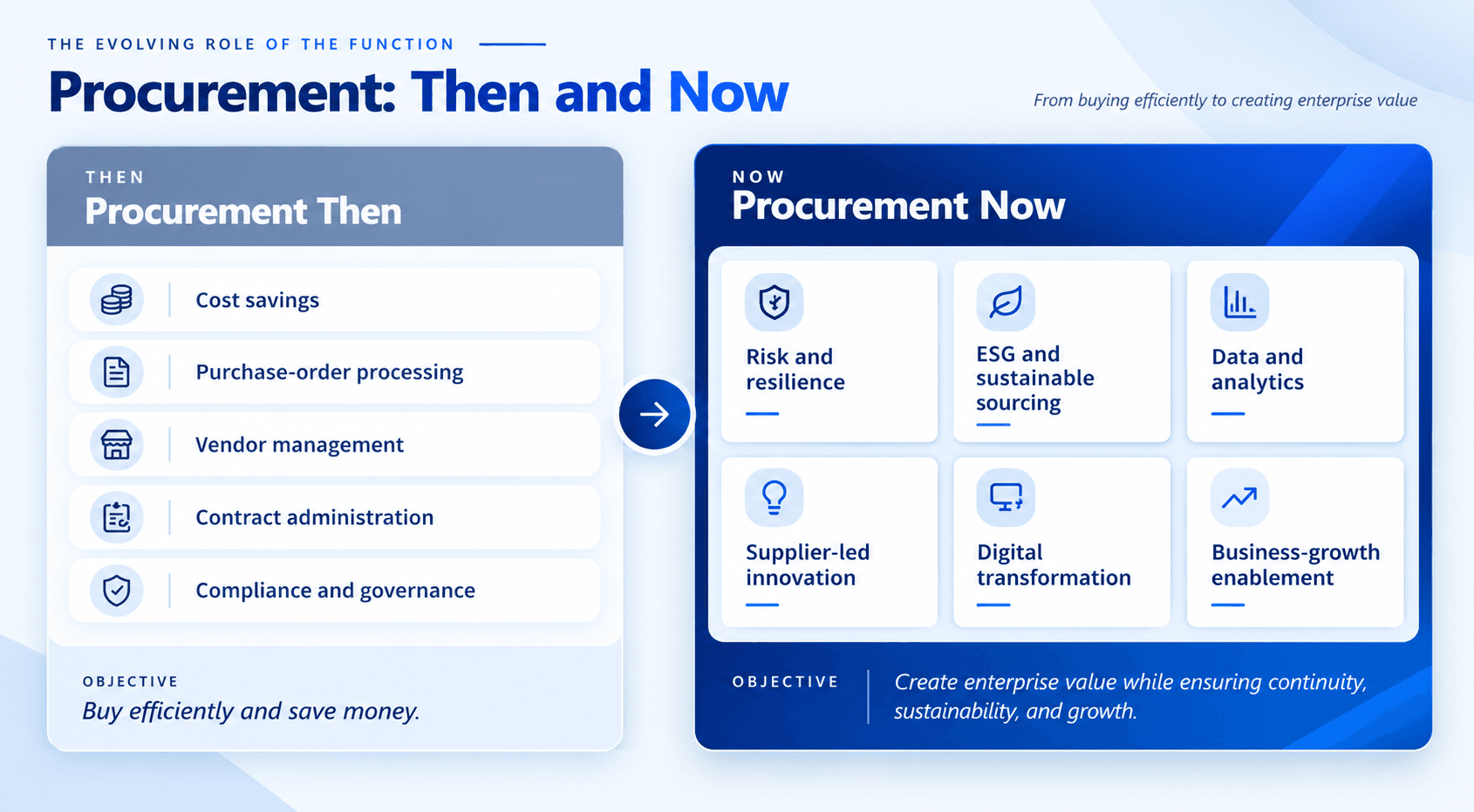
The Turning Point
Over the past decade, procurement has lived through a series of wake-up calls:
Global pandemics that severed supply chains overnight.
Geopolitical conflict that redrew established trade routes.
Inflation that intensified cost pressure across every category.
Expanding regulatory and reporting requirements.
Sustainability moving firmly onto the boardroom agenda.
Digital technologies reshaping how decisions are made.
Together, these forces exposed a simple truth: "The cheapest supplier is not always the best supplier."
Organizations began to look past unit price and prioritize resilience, agility, innovation, and long-term value. Procurement was no longer asked merely to negotiate contracts; it was expected to protect continuity and actively enable growth.
The Evolution of Procurement
The path from a cost-control function to a strategic partner has followed a recognizable arc:
e path from a cost-control function to a strategic partner has followed a recognizable arc:
2015 — Cost-Reduction Focus
Strategic sourcing adoption
Category management
Supplier collaboration
Digital procurement platforms
Risk-management integration
ESG and responsible sourcing
Data-driven decision-making
AI and predictive analytics
2025 onward — Strategic Business Partner
Five Forces That Changed Procurement Forever
1. Digital Transformation
Automation, artificial intelligence, spend analytics, and cloud platforms have stripped away transactional work, freeing teams to concentrate on strategy. Manual procurement has given way to intelligent procurement.
2. Supply-Chain Resilience
Recent disruptions proved that continuity of supply matters as much as cost optimization. Organizations now invest deliberately in:
Supplier diversification
Business-continuity planning
Continuous risk monitoring
End-to-end supply-chain visibility
3. Sustainability and ESG
Because so much of an organization's environmental and social footprint originates in its supply chain, procurement sits at the center of the sustainability agenda. Today's leaders help deliver:
Responsible sourcing
Supplier diversity
Carbon-reduction goals
Ethical supply-chain practices
4. Supplier Innovation
The buyer-supplier relationship has shifted from transactional to collaborative. Suppliers are increasingly treated as strategic partners that contribute ideas, technology, and market insight rather than simply fulfilling orders.
5. Data-Driven Decision-Making
Modern teams work with real-time intelligence that supports faster, better choices. Rather than reacting to events, procurement leaders can now anticipate disruption, surface opportunity, and drive outcomes through predictive insight.
Procurement's New Seat at the Table
Today's procurement leaders take part in conversations once considered well outside their remit. They now help shape:
Corporate strategy
Enterprise risk management
Digital transformation
Sustainability programs
Mergers and acquisitions
Supply-chain redesign
Market-expansion initiatives
Procurement is no longer judged by savings alone. It is measured by its ability to create value, reduce risk, enable innovation, and sustain long-term success.
Looking Ahead
The next chapter is already being written. Artificial intelligence, predictive risk intelligence, autonomous sourcing, connected supplier ecosystems, and real-time market intelligence will keep redefining how organizations buy, collaborate, and grow.
The teams that embrace these capabilities will not merely support the business. They will help shape their future.
Closing Thought
The last decade has carried procurement from a function focused on transactions to one focused on transformation.
From managing spend to managing strategy.
From negotiating prices to navigating uncertainty.
From supporting operations to enabling growth.
Procurement has earned its place as a strategic powerhouse at the heart of modern business.
Get in Touch with Us
Get in touch with us to discuss your strategic needs and how we can help you develop a plan to accelerate your growth
Schedule a ConsultationRelated Articles

The Shift from Supply Chains to Value Networks
Industrials
7 Untapped Procurement Metrics That Reveal Hidden Value
Industrials
Why Process Mapping Is the Foundation of Procurement Excellence
Industrials