The Shift from Supply Chains to Value Networks

For decades, we talked about supply chains the way engineers talk about pipelines: raw materials go in one end, finished goods come out the other and success means moving things through as fast and as cheaply as possible.
It was a linear story with a beginning, a middle and an end.
That story is no longer accurate. Honestly, it hasn’t been for a while.
The organizations I work with today aren’t managing chains anymore. They’re managing networks: webs of suppliers, partners, logistics providers, technology platforms and customers, all exchanging information and value in directions that have nothing to do with a straight line.
The companies that still think in terms of “chains” are the ones getting caught flat-footed by disruption.
The ones thinking in terms of “networks” are the ones turning volatility into an advantage.
From Linear Flow to Networked Value
A supply chain is built around sequence:
Supplier → Manufacturer → Distributor → Retailer → Customer
It assumes that value moves in one direction, that each link only needs to communicate with the link next to it and that the biggest risk is a broken connection somewhere along the line.
A value network doesn’t work that way.
Suppliers can talk directly to customers through data. Manufacturers can co-design products with partners three tiers removed. Demand signals can move upstream in real time instead of waiting for a purchase order.
The question is no longer:
“How do we move goods from A to B?”
It is:
“Where in this web is value being created and where is it leaking out?”
Answering that question requires something most organisations still don’t have: genuine connected Network Visibility into how every node, internal and external, is actually performing rather than simply how it looked in last quarter’s report.
The Tier-Two Blind Spot Most Leaders Are Still Sitting On
Here’s something I bring up constantly with operations and procurement leaders:
Most companies have decent visibility into their direct Tier 1 suppliers.
Almost none have real visibility beyond that.
Think about it.
You’ve negotiated hard with your primary vendors. You track their performance. But the moment something happens two or three tiers upstream, such as a component shortage, factory shutdown or geopolitical disruption, most organisations find out about it the same way everyone else does:
After it’s already too late to react.
That blind spot is quiet and it compounds.
What It Can Hide
Single points of failure: Dependencies hidden several tiers deep that never show up in a standard vendor scorecard.
Duplicate sourcing risk: Business units that don’t talk to each other may all be relying on the same upstream supplier without knowing it.
Slow disruption response: Information travels through phone calls and email chains instead of connected systems.
Lost negotiating leverage: Spend and volume are fragmented across regions and never consolidated into one picture.
Sustainability and compliance exposure: Finance and legal teams discover issues only after a headline forces the issue.
None of these feel urgent in isolation.
But across a network of any real size, they can add up to millions in avoidable costs. Worse, they reflect a structural lack of visibility that a modern operations leader simply can’t afford.
Value Network Thinking Is Not About Adding More Vendors
One of the biggest misconceptions I run into is that building a value network means diversifying for diversification’s sake: adding more suppliers, more redundancy and more nodes.
I’d push back on that firmly.
Building a real value network isn’t about having more relationships. It’s about having the right visibility and the right connections between the relationships you already have.
You’re not trying to complicate the web.
You’re trying to see it clearly enough to make it work for you instead of against you.
The organisations leading this shift are using data and orchestration platforms to get closer to their network, not to add more moving parts to it.
They’re building systems where signals flow in both directions, risk surfaces before it becomes a crisis and every node, whether a supplier, logistics partner or customer, becomes a source of information rather than just a transaction.
What a Real Value Network Actually Looks Like
I’ve seen what happens when organisations get this right and it changes how they operate at a fundamental level.
A real value network doesn’t just digitise the old supply chain.
It reimagines how value moves end to end.
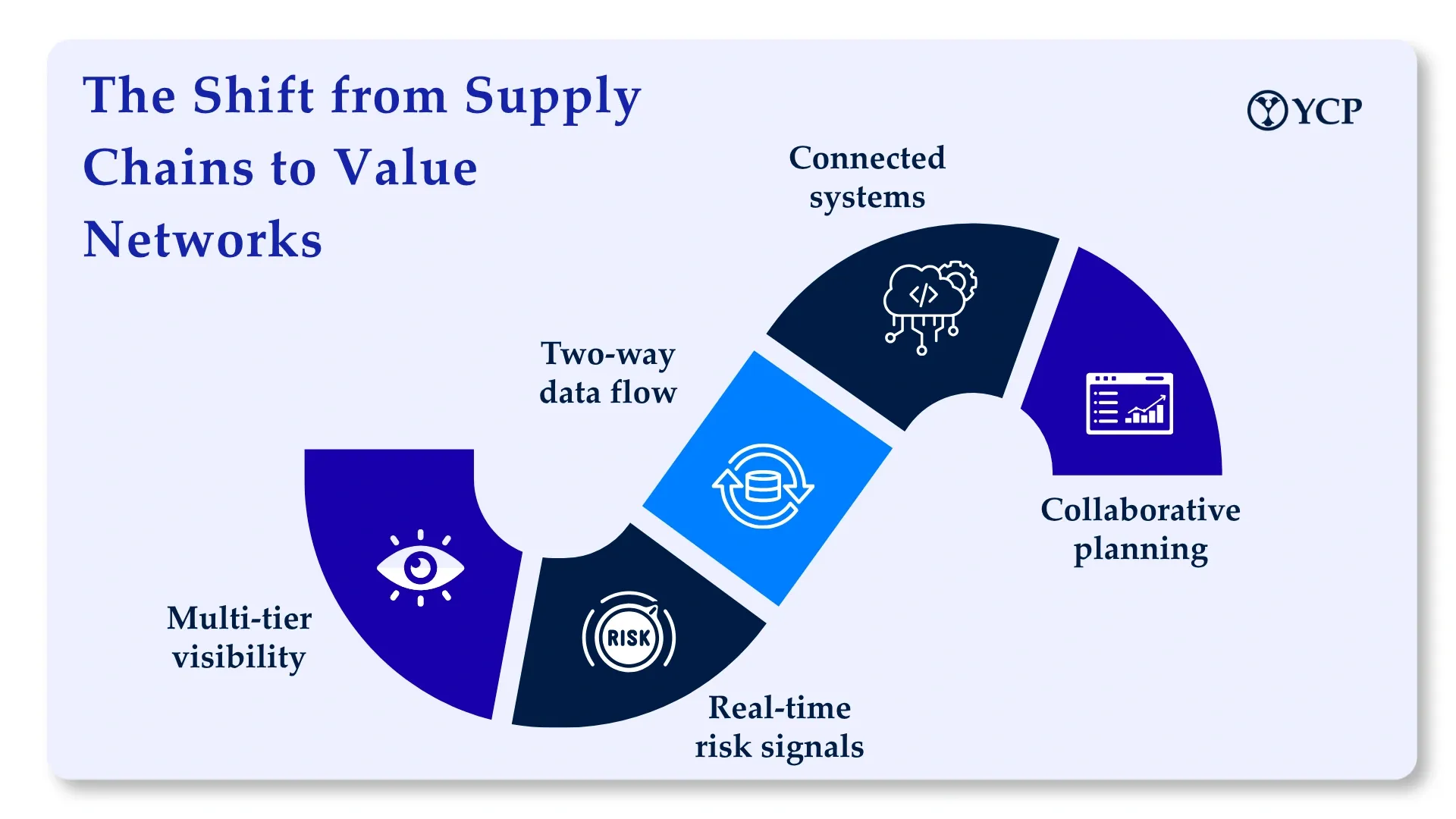
In practice, this means:
Multi-tier visibility: Extending beyond direct suppliers into the partners behind your partners.
Real-time risk signals: Surfacing disruption before it reaches your production line or your customer.
Two-way data flow: Moving demand information upstream as quickly as goods move downstream.
Connected systems: Linking procurement, logistics and finance so teams aren’t constantly reconciling spreadsheets.
Collaborative planning: Treating suppliers and partners as co-owners of the outcome rather than simply vendors.
When this infrastructure is in place, leaders stop reacting to disruption after the fact.
They start anticipating it.
They renegotiate from a position of visibility instead of guesswork.
They see exactly where value is being created and where it’s quietly being destroyed.
The Strategic Leader Has Full Network Visibility
I’ll be direct:
You cannot lead a resilient operation without genuine connected visibility across your value network.
If your supplier data lives in disconnected spreadsheets, siloed systems or gets consolidated once a quarter in a business review, you don’t have a supply chain problem.
You have a visibility problem.
And visibility problems always turn into disruption problems, usually at the worst possible time.
The leaders I respect most treat network visibility the same way they treat financial forecasting or demand planning: as foundational infrastructure rather than a nice-to-have.
It is a requirement for making good decisions.
The Evolution Is Already Happening
The supply chain of today is not a chain at all.
It’s a living adaptive network.
The leaders who thrive are the ones who stopped managing it like a pipeline years ago. They’re the people helping their organisations understand not just what happened last quarter but what’s likely to happen next and which relationships in which corner of the network are worth investing in.
Getting there requires investment in the right platforms, the right partnerships and the right mindset.
It means treating Network Visibility and value orchestration not as a logistics upgrade but as a strategic priority that directly affects how resilient and competitive your business can be.
The Question Leaders Need to Ask
If you’re a supply chain or operations leader reading this, ask yourself one question:
Do you have real visibility into how value is actually moving across your network right now?
Not just through your direct suppliers.
But through the tiers behind them.
If the answer is anything other than an immediate yes, there’s an opportunity in front of you.
And the leaders who seize it are the ones who will define what resilient value-driven operations look like going forward.
Get in Touch with Us
Get in touch with us to discuss your strategic needs and how we can help you develop a plan to accelerate your growth
Schedule a ConsultationRelated Articles

7 Untapped Procurement Metrics That Reveal Hidden Value
Industrials
Procurement Transformation: From Cost to Strategic Value
Industrials
Why Process Mapping Is the Foundation of Procurement Excellence
Industrials