Why Business Transformation Should Be Designed Like an Investment Portfolio

Companies apply strict discipline to every dollar on the balance sheet. Then they approve a transformation as one single bet, size it once and never review it again.
Transformation is typically designed as a plan when it should be designed as an investment portfolio.
The Problem With Treating Transformation as a Plan
No CFO would allow the treasury team to hold one investment position, size it once and ignore it for the next three years.
Yet the same CFO may approve a three-year supply chain transformation that does exactly this.
The business case is built. The capital is released. The scope is fixed. Then the programme runs until someone declares it finished.
This is the gap we keep finding in our procurement diagnostics.
A plan has a fixed scope, one approval and a completion date.
A portfolio has multiple positions, capital released in stages and someone actively managing where resources go next.
The difference is not semantic. It changes how transformation is funded, governed and managed.
Transformation Is Managed Worse Than Capital
The statistics do not encourage confidence.
A consulting company surveyed more than 400 executives in 2024. Around a third of large organisations are running a transformation at any given moment and only 12% reach the ambition they set at the start.
Now look at how capital moves inside those same companies.
Another large consulting company tracked more than 1,600 US companies over 15 years. The average company shifts 8% of its capital between businesses from one year to the next. A third of them shift just 1%.
Companies that reallocate actively return around 10% to shareholders. The slower ones return 6%. Over 20 years the active reallocator is worth twice as much.
Put the two findings together and the picture is clear.
Transformations do not necessarily fail because the wrong initiatives were selected. They fail because the allocation is frozen at the moment of project approval, which is the moment the organisation knows the least about how the project will actually perform.
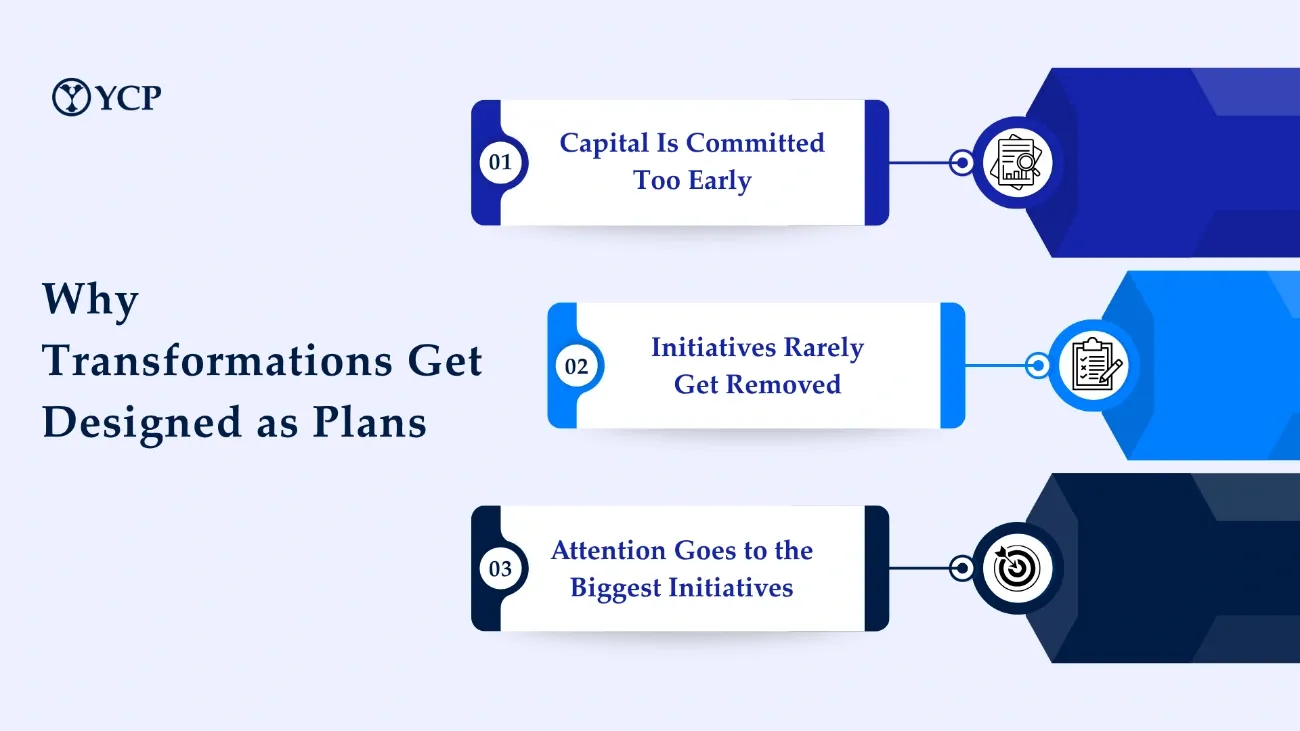
Why Transformations Get Designed as Plans
Three structural issues keep pushing organisations towards a plan-based approach.
1. Capital Is Committed Too Early
Capital is released once against a business case at the point of highest uncertainty. There is no second decision point built into the process.
2. Initiatives Rarely Get Removed
Initiatives get added but almost never removed.
A tail-spend project from two years ago is still open. Nobody wants to close it because closing it means admitting the case was wrong. These projects also often carry the name of the executive who sponsored them.
The result is a portfolio that accumulates initiatives without actively reallocating resources away from those that are no longer creating sufficient value.
3. Attention Goes to the Biggest Initiatives
The same consulting company mentioned above found that around half of total program value comes from smaller initiatives rather than the large ones.
Everyone watches the ERP replacement.
Nobody watches the forty contract renegotiations that together may be worth more.
The largest initiative is not necessarily the most valuable position.
What Portfolio Design Requires
If transformation is treated as an investment portfolio then five principles become critical.
1. Size the Positions Before You Fill Them
Decide the mix first.
How much goes to near-term savings? How much goes to structural change?
Another research study found that companies put around 70% of resources into core work while around 70% of long-term return comes from transformational work.
In procurement this can show up as a roadmap that is 90% sourcing waves and 10% everything else followed by surprise when the operating model never changes.
The lesson: allocate resources across different types of value before filling the portfolio with individual initiatives.
2. Underwrite on Risk-Adjusted Value
A $5M initiative at 40% confidence is worth less than a $3M initiative at 90%.
Most business cases quantify the prize but stay silent on the probability.
Ask for both.
A category strategy facing a hostile supply base with no internal sponsor should not carry the same weight as one with three qualified alternative suppliers already identified.
The lesson: evaluate initiatives based on expected value rather than headline value alone.
3. Release Capital in Tranches
A strategy behaves like a series of options rather than a single cash flow.
Fund the first gate. Look at the evidence. Then fund the next.
A control tower does not need three years of budget on day one.
The lesson: funding should follow evidence rather than simply follow the original business case.
4. Rebalance on a Fixed Cadence
Put a quarterly reallocation decision into the governance calendar.
Not a status update.
A decision on where the money and people move next.
The default answer should be redirection rather than continuation.
The lesson: governance should actively decide where resources create the greatest value next.
5. Write the Exit Before You Start
Every initiative should carry its own archiving criteria and a deadline.
If stopping a project is a career problem then nobody will ever stop one. The portfolio fills with positions that nobody can close.
The lesson: every initiative needs a defined exit condition before it receives significant investment.
Where the Comparison Breaks
We should be honest about where the analogy stops working.
Your Positions Are Correlated
Diversification works in finance because assets can move independently.
Transformation initiatives do not.
They share the same ERP, the same master data and the same teams.
Researchers found that the strongest predictor of failure is overloading star performers. In portfolio language that is a single risk factor sitting underneath every position you hold.
Your S2P automation, supplier consolidation and data governance work may all depend on the same people in the category team.
So diversification alone is not enough.
You also need to understand the dependencies connecting the positions in your portfolio.
You Cannot Manage a Portfolio You Cannot See
Every principle above assumes something that most organisations do not have:
A complete list of what is actually running
What each initiative is worth once probability is applied
What each initiative depends on
Who each initiative consumes
No fund manager would accept a position book they had not reconciled.
Most transformation offices work from exactly that.
The first act of portfolio design is therefore not the allocation decision.
It is the baseline.
Before deciding where to invest more you need to know what you already have, what it is worth and what it depends on.
What We Can Take From This Approach
Transformation does not fail because companies choose the wrong initiatives. It fails because they choose once.
The initiatives are approved together, funded together and then left alone while the market, the supply base and the organisation keep moving.
A portfolio is not something you complete.
It is something you hold and actively manage.
The question for transformation leaders is therefore not simply:
“Did we deliver the plan?”
It is:
“Are we continuously allocating our people, capital and attention to the initiatives that can create the greatest value?”
That is the shift from managing transformation as a program to managing it as an investment portfolio.
Get in Touch with Us
Get in touch with us to discuss your strategic needs and how we can help you develop a plan to accelerate your growth
Schedule a Consultation