Why Category Strategy Needs to Become Investment Strategy

A few months back, I sat through a category strategy presentation that had everything: Kraljic matrix, supplier segmentation, a neat little SWOT for every sub-category and a five-year demand forecast.
Polished. Textbook. And completely useless the moment the CFO asked one question:
“What return am I getting on this?”
Nobody had an answer.
Because nobody had built one in.
That’s the gap I keep running into across clients and honestly across my own career before I started thinking differently about it. We’ve gotten very good at category strategy as a planning exercise. We are still bad at category strategy as a capital allocation exercise.
Those are not the same thing and the difference is starting to cost procurement teams their seat at the table.
The Old Playbook Was Built for a Different Problem
Traditional category strategy answers questions like:
Who are our suppliers?
What’s our spend?
Where’s the risk?
How do we consolidate?
All fair questions. But they are largely backward-looking or at best defensively forward-looking.
The whole framework was built in an era when procurement’s job was to protect the business from supply risk and squeeze cost out of a relatively stable base.
That world doesn’t exist anymore.
Supply chains break because of a conflict in the Strait of Hormuz, not just because a supplier goes bankrupt. Input costs move because of a tariff announcement, not just a bad harvest.
And the business isn’t just asking “Are we protected?”
It’s asking:
“Are we positioned?”
Those are investment questions, not traditional procurement questions.
Which means category strategy has to start answering them like an investment strategy.
What Does “Investment Strategy” Actually Mean Here?
I’m not talking about procurement literally managing a portfolio of financial assets.
I mean borrowing the discipline of investment thinking and applying it to categories.
1. Every Category Is a Position, Not a Line Item
A portfolio manager doesn’t ask, “How do I manage this stock?”
They ask:
“What’s my thesis on this position? What’s my time horizon? What’s my exit if the thesis breaks?”
Try asking that about your top ten categories.
Most teams can’t because nobody wrote a thesis.
They wrote a sourcing plan.
2. Capital Has an Opportunity Cost and So Does Category Effort
Every hour a category manager spends and every rupee committed to a supplier relationship is capital that could have gone somewhere else.
If you can’t articulate why nickel components deserve more strategic attention this year than packaging then you’re not allocating. You’re just doing whatever’s loudest.
3. Think in Terms of Risk-Adjusted Return, Not Just Savings
A 12% savings number from a single-source supplier in a geopolitically exposed corridor is not the same 12% as a 6% savings number from a diversified resilient base.
Investment thinking forces you to price the risk into the return instead of reporting them as if they live in separate worlds.
4. Rebalancing Is a Discipline, Not a Crisis Response
Investors rebalance portfolios on a schedule, not just when something blows up.
Category strategy today is almost entirely reactive. We revisit a category when the supplier fails or the contract expires.
An investment mindset says you review the position quarterly and ask whether the thesis still holds, win or lose.
Why This Matters Right Now
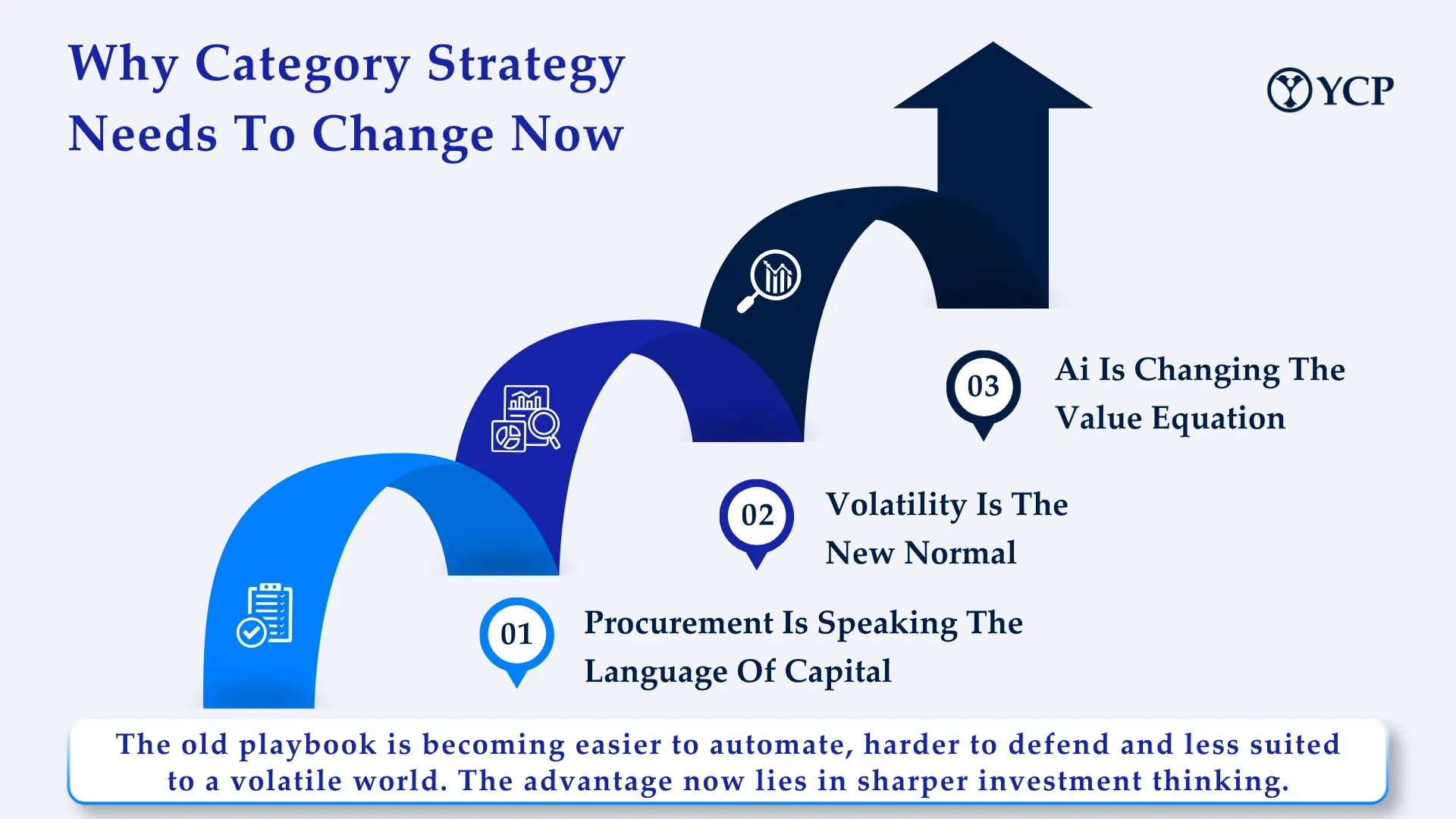
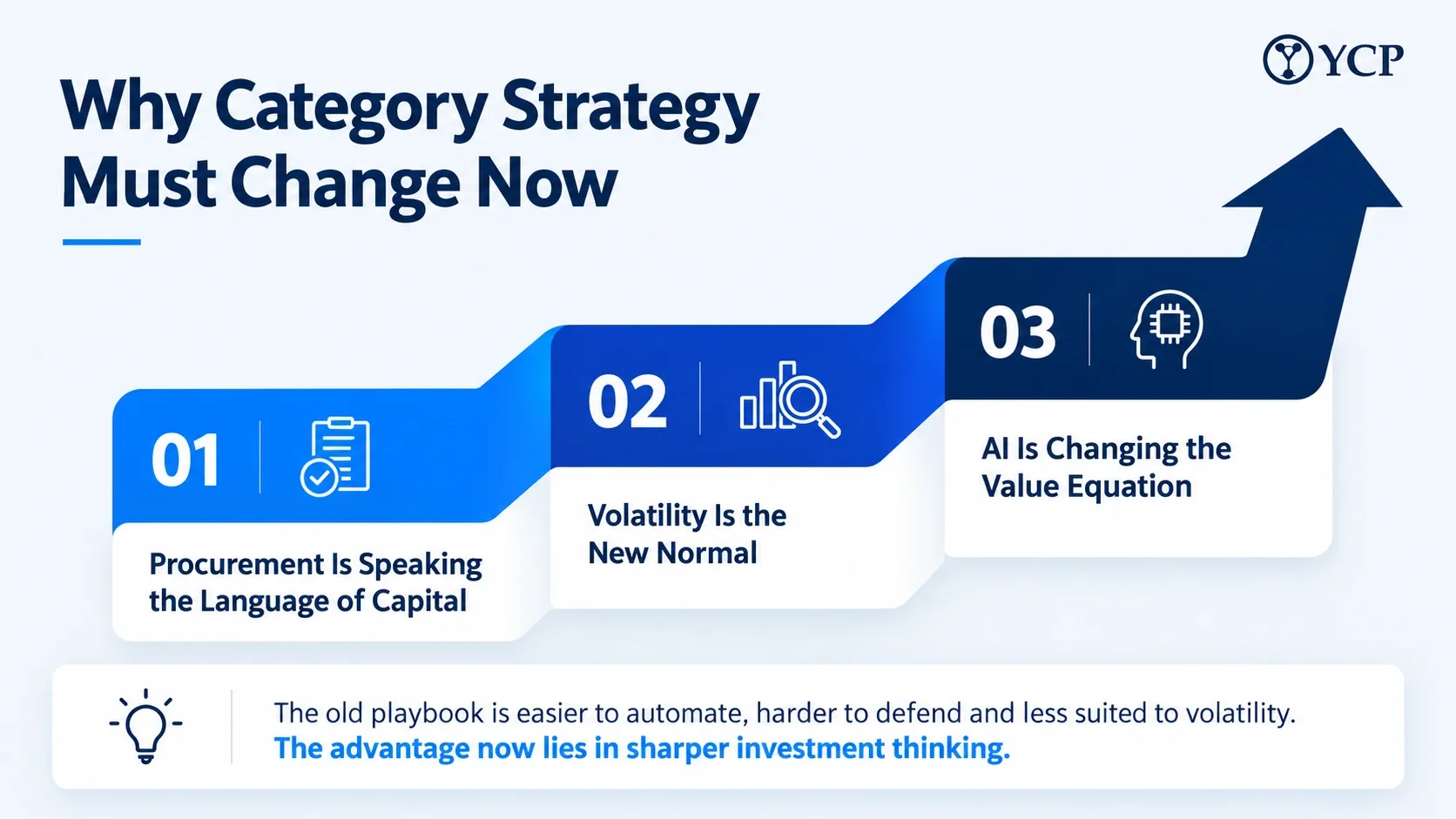
Three things are converging that make this urgent rather than aspirational.
1. Procurement Is Being Asked to Speak the Language of Capital
Boards are asking procurement leaders questions that used to go to CFOs and treasury:
How are we managing our exposure?
Where should we deploy capital for supplier development?
Is make-versus-buy a financing decision?
If category owners can’t speak that language then someone else answers those questions for them.
And the function loses ground.
2. AI Is Commoditizing the Old Category Strategy Work
AI and automation are collapsing the time it takes to do the old category strategy work: data gathering, spend analysis and supplier scoring.
That’s good news.
But it means the differentiator is no longer who can build the cleanest matrix.
It’s who can build the sharpest thesis.
The mechanical work is getting commoditized.
The judgment work is where the value has moved.
3. Volatility Is Not a Phase We Are Passing Through
Between Gulf tensions, tariff whiplash and currency swings, categories that looked “low risk” two years ago aren’t automatically low risk today.
A static strategy document written for a stable world is already out of date the day it is approved.
What Does This Look Like in Practice?
It’s not a wholesale reinvention.
It’s a shift in the questions you ask before you write the category plan.
Instead of Asking:
“What’s our sourcing strategy for this category?”
Ask:
“What’s our thesis and what would prove it wrong?”
Instead of Asking:
“How much can we save?”
Ask:
“What’s the risk-adjusted value of this position and is it earning its place in the portfolio?”
Instead of Reviewing Categories on Contract Cycles:
Put them on a rebalancing calendar just as a fund reviews its holdings regardless of whether anything dramatic happened.
Instead of Using Savings as the Only KPI:
Run a simple exposure-versus-return view across the top categories so leadership can see the portfolio rather than twelve disconnected plans.
None of this needs a new tool or a six-month transformation program. It needs category owners to stop thinking like buyers defending a budget and start thinking like allocators defending a portfolio.
The Honest Bit
This is a harder story to tell internally because it asks category managers to own outcomes rather than just process.
A sourcing plan is easy to defend.
You did the RFQ. You ran the negotiation. You hit the savings number.
A thesis can be wrong.
That’s uncomfortable.
But it’s also exactly the kind of accountability that gets procurement invited into the conversations that currently happen without us.
The category strategies that will matter over the next few years won’t be the ones with the most detailed supplier segmentation.
They’ll be the ones that can answer in one sentence:
Why does this category deserve the capital and attention it’s getting?
And:
What would make us change our mind?
From Category Plan to Investment Thesis
That’s the real shift.
Category strategy can no longer be just a document that explains what procurement intends to do.
It needs to explain where procurement is choosing to invest its capital, time and attention and why.
That’s not a procurement document anymore. That’s an investment memo. It’s time our category strategies read like one.
Get in Touch with Us
Get in touch with us to discuss your strategic needs and how we can help you develop a plan to accelerate your growth
Schedule a Consultation