Why Finance Leaders Need Real-Time Spend Visibility

For years, the role of the CFO was largely defined by financial control. Closing the books on time, ensuring compliance, managing audits and maintaining financial discipline were considered the primary measures of success. While these responsibilities remain essential, they no longer define the full scope of modern finance leadership.
Today, CFOs are expected to influence business strategy, guide investment decisions, support digital transformation initiatives and help organizations navigate an increasingly complex economic landscape. They are no longer viewed solely as financial gatekeepers. They are strategic partners responsible for helping the business grow sustainably while managing risk and preserving profitability.
This evolution has fundamentally changed the way finance leaders operate. Historical reporting alone is no longer enough. To make informed decisions, CFOs need access to timely, accurate and actionable data that provides a clear picture of how resources are being utilized across the organization.
The New Expectations Placed on CFOs
Business leaders are operating in an environment characterized by rising costs, economic uncertainty, evolving workforce expectations and increased pressure to improve efficiency. In this environment, the CFO has become one of the most influential voices in the executive leadership team.
Finance leaders are now expected to answer questions that extend well beyond traditional financial reporting:
Where are opportunities to improve operational efficiency?
Which investments are generating measurable business value?
How can the organization optimize spending without impacting growth?
What risks could affect profitability in the coming quarters?
How can financial data support better strategic decision-making?
Providing meaningful answers requires a level of visibility that many organizations still struggle to achieve.
The Hidden Challenge of Employee Spend
One area that continues to create challenges for finance teams is employee-driven spending, particularly travel and expenses.
Unlike large procurement contracts or planned capital expenditures, travel and expense transactions occur daily across different departments, locations and employee groups. Individually, these expenses may appear insignificant. Collectively, they can represent a substantial portion of organizational spending.
Despite this, many companies continue to manage travel and expense processes through disconnected systems, manual reviews, spreadsheets and paper-based workflows. As organizations grow, these approaches become increasingly difficult to manage and control.
The result is often a lack of visibility into how money is being spent until after expenses have already been incurred.
This can lead to:
Policy violations that are identified too late
Duplicate or inaccurate claims
Inconsistent approval processes
Limited visibility into spending patterns
Missed opportunities for supplier negotiations
Delayed reimbursements that negatively impact employee experience
While none of these issues may appear significant in isolation, together they create unnecessary costs, administrative burden and operational inefficiencies.
Why Finance Automation Matters
Finance automation is often viewed primarily as a cost-reduction initiative. In reality, its greatest value lies in enabling finance teams to focus on higher-impact activities.
When routine processes such as expense reporting, approvals, policy checks and reconciliations are automated, finance professionals spend less time managing transactions and more time analyzing trends, identifying opportunities and supporting strategic initiatives.
Automation improves speed and accuracy, but more importantly, it improves visibility.
Instead of waiting weeks or months for reports to be consolidated, finance leaders gain access to real-time insights. Exceptions can be flagged automatically. Spending trends become easier to identify. Decision-makers can respond proactively rather than reactively.
This shift allows finance teams to move from processing information to generating business intelligence.
What Effective Travel and Expense Management Looks Like
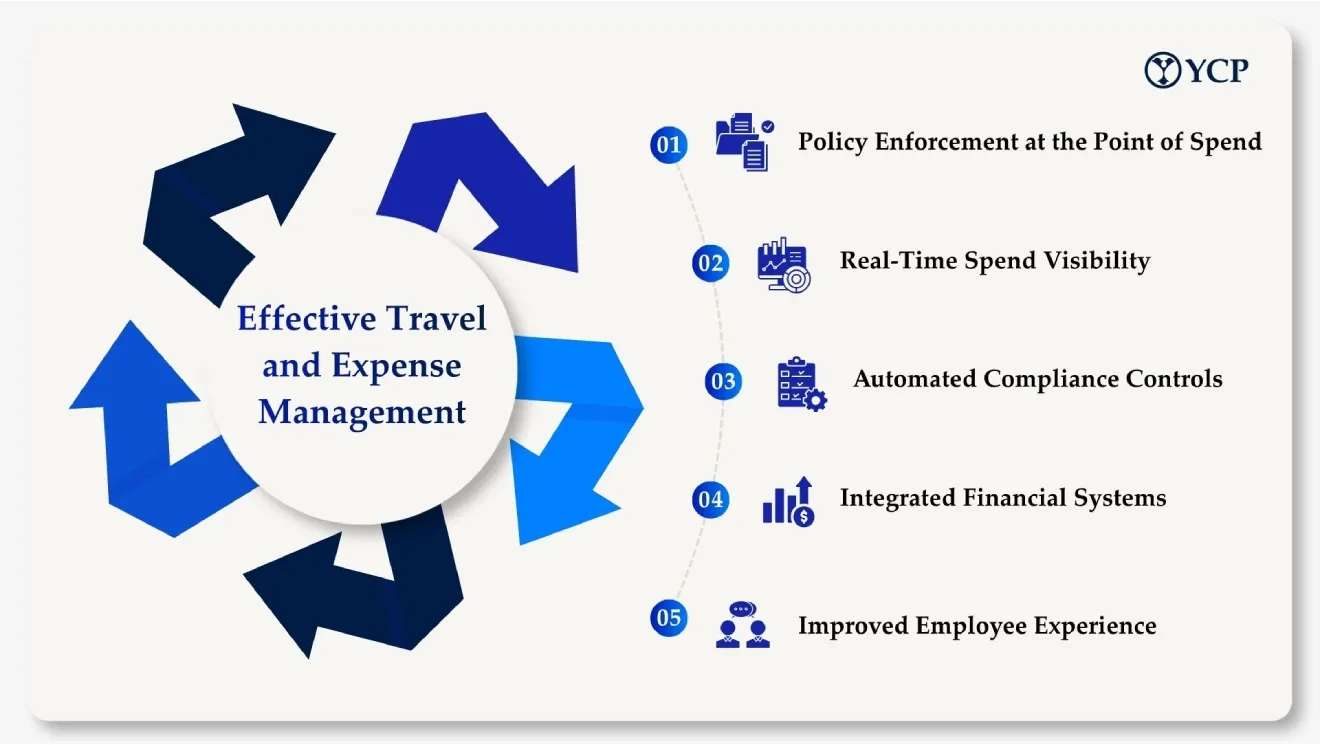 The most successful organizations do not treat travel and expense management as an administrative process. They view it as an important component of financial governance and spend management.
A modern travel and expense program typically includes:
Policy Enforcement at the Point of Spend
Employees are guided toward compliant choices before expenses occur rather than being corrected afterward.
Real-Time Spend Visibility
Finance leaders have immediate access to spending data across departments, locations and categories.
Automated Compliance Controls
Duplicate claims, policy violations and unusual transactions are identified automatically before reimbursement.
Integrated Financial Systems
Expense data flows seamlessly into ERP, accounting, payroll and HR systems, reducing manual intervention and improving accuracy.
Improved Employee Experience
Faster approvals and reimbursements create a smoother process for employees while maintaining appropriate financial controls.
When these capabilities are in place, finance teams gain a clearer understanding of spending behavior across the organization. They can identify cost-saving opportunities, strengthen supplier negotiations and allocate resources more effectively.
Visibility Is the Foundation of Strategic Finance
Many organizations focus heavily on budgeting and forecasting while overlooking the importance of spend visibility.
Yet strategic decisions are only as good as the information supporting them.
Without a complete view of organizational spending, finance leaders are forced to make decisions based on partial information. Hidden costs remain hidden. Emerging trends go unnoticed. Opportunities for optimization are missed.
Visibility is not simply a reporting requirement. It is a strategic capability.
Organizations that provide their CFOs with comprehensive, real-time insights into spending are better equipped to control costs, improve operational efficiency and make confident investment decisions.
The Future of Finance Leadership
The role of the CFO will continue to expand as businesses become more data-driven and interconnected. Financial expertise will always remain at the core of the position, but future success will increasingly depend on a CFO's ability to translate data into strategic action.
Modern finance leaders are expected to help organizations anticipate change, evaluate opportunities and make smarter decisions faster. Achieving this requires more than strong financial processes. It requires visibility, automation and access to reliable information across the enterprise.
The transition from financial steward to strategic business leader is already well underway. Organizations that invest in the systems and capabilities needed to support this evolution will be better positioned to compete, grow and create long-term value in an increasingly complex business environment.
This version removes most of the AI-style conversational fillers, sounds more executive and consultative and reads like a thought-leadership article from a consulting firm, finance publication, or CFO advisory practice rather than AI-generated content.
Get in Touch with Us
Get in touch with us to discuss your strategic needs and how we can help you develop a plan to accelerate your growth
Schedule a ConsultationRelated Articles

Control Before Spend: The Next Evolution in T&E
Financial Services
The Handoff Nobody Talks About: Where Strategic Sourcing Meets Source-to-Pay
Financial Services
The Four Pillars of High-Performing Source-to-Pay Organizations
Financial Services