Why Indirect Procurement Has Become a Strategic Imperative

The difference between high-performing procurement organizations and everyone else often comes down to how well they manage indirect spend.
As businesses face growing pressure to improve efficiency and control costs, indirect procurement has become a strategic priority.
This article examines the role of indirect procurement, its key challenges and the strategies organizations use to improve spend visibility, strengthen compliance and drive measurable business value.
Why Indirect Procurement Matters More Than Ever
Indirect procurement encompasses all goods and services required to operate a business that do not directly become part of the final product or service.
Typical categories include:
IT hardware, software and cloud services
Marketing and advertising
Professional and consulting services
Travel and expense management
Human resources and talent solutions
Facilities management
Maintenance, Repair and Operations (MRO)
Utilities and workplace services
Historically, these categories were viewed as unavoidable operating expenses. Today, they are increasingly viewed as strategic spend categories capable of influencing business performance across multiple dimensions.
Unlike direct procurement, indirect spend touches every employee, every department and nearly every business process. Small inefficiencies multiplied across hundreds or thousands of transactions can translate into significant financial leakage.
For many enterprises, indirect procurement is no longer a back-office activity. It is a boardroom discussion.
The Real Challenge Isn't Spend. It's Visibility.
Most organizations do not have a spending problem.
They have a visibility problem.
Procurement leaders frequently encounter:
Duplicate software subscriptions across departments
Multiple suppliers providing similar services
Unmanaged contract renewals
Maverick spending outside approved channels
Fragmented supplier relationships
Inconsistent pricing and contract terms
Without centralized visibility, procurement teams are forced to react rather than proactively manage spend.
This challenge becomes even more pronounced as organizations adopt SaaS applications, subscription-based services and decentralized purchasing models.
The result is hidden costs that quietly erode margins year after year.
The Rise of AI-Powered Indirect Procurement
The next evolution of indirect procurement will be driven by intelligence rather than automation alone.
Artificial intelligence is helping procurement teams:
Identify hidden savings opportunities
Detect non-compliant purchases
Predict supplier risks
Automate sourcing decisions
Improve contract management
Optimize purchasing behavior
Rather than spending time gathering data, procurement professionals can focus on stakeholder engagement, supplier innovation and strategic decision-making.
Organizations that successfully combine AI capabilities with procurement expertise will achieve a significant competitive advantage over the coming decade.
Four Strategic Priorities for Procurement Leaders
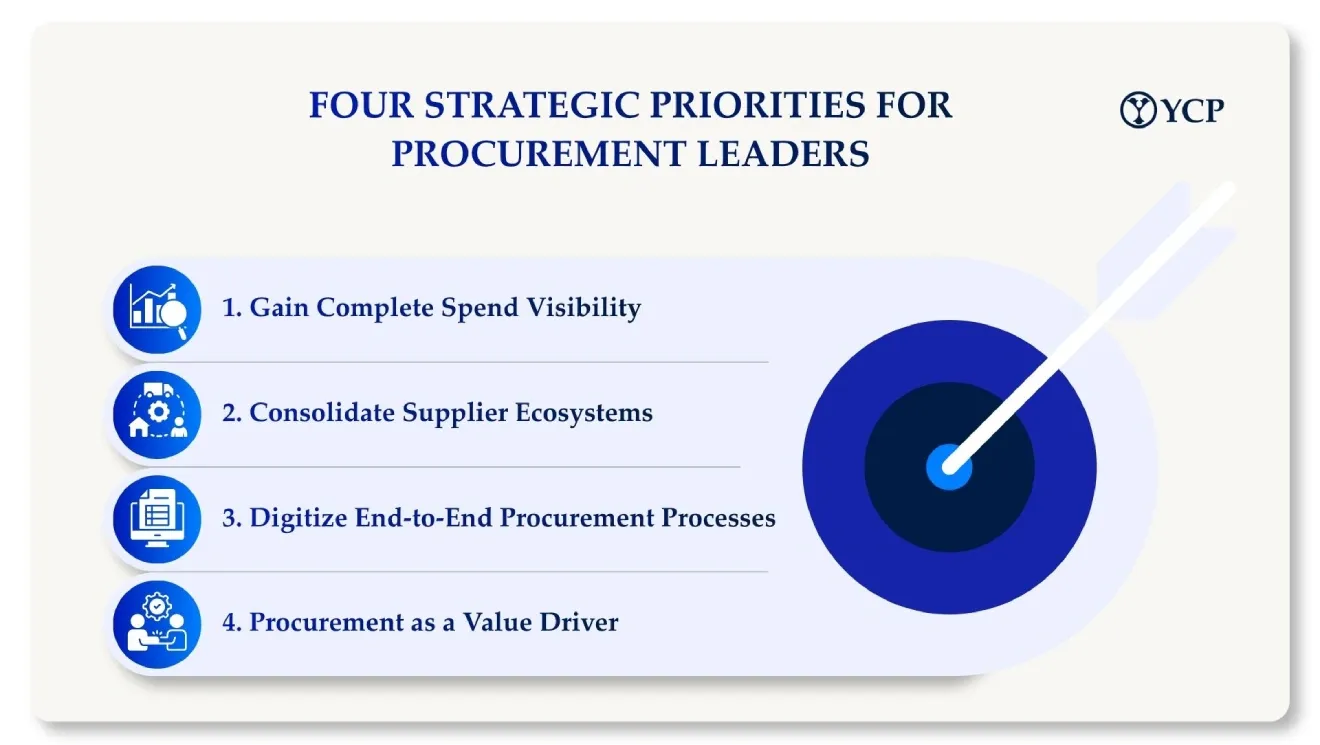
Gain Complete Spend Visibility
Visibility remains the foundation of effective procurement. Organizations cannot optimize spending they cannot see.
Consolidate Supplier Ecosystems
Reducing supplier fragmentation improves leverage, simplifies management and strengthens governance.
Digitize End-to-End Procurement Processes
Automation reduces administrative effort while improving speed, compliance and accuracy.
Procurement as a Value Driver
The most successful procurement teams are measured not only by savings but by their contribution to business outcomes, innovation, resilience and growth.
Looking Ahead
Indirect procurement is entering a new phase of maturity. As organizations seek greater efficiency, agility and profitability, indirect spend is becoming one of the most important areas for strategic intervention. The winners will not be those that simply negotiate lower prices. They will be those that create greater visibility, make faster decisions, leverage technology intelligently and align procurement objectives with broader business goals.
In the years ahead, indirect procurement will no longer be viewed as a support function. It will be recognized for what it truly is: a critical driver of enterprise value.
Get in Touch with Us
Get in touch with us to discuss your strategic needs and how we can help you develop a plan to accelerate your growth
Schedule a ConsultationRelated Articles

Control Before Spend: The Next Evolution in T&E
Financial Services
The Handoff Nobody Talks About: Where Strategic Sourcing Meets Source-to-Pay
Financial Services
The Four Pillars of High-Performing Source-to-Pay Organizations
Financial Services