Why Most RFP Responses Fail to Differentiate

Every organization wants to believe its RFP response stands out from the competition.
Yet, most responses sound remarkably similar — and that is why proposal teams need to rethink their approach and positioning.
The same buzzwords. The same claims of “innovation,” “customer-centricity,” and “end-to-end capabilities.” The same long lists of features that appear in almost every sales pitch continue to dominate response packages.
As procurement and business teams evaluate multiple vendors, differentiation becomes increasingly difficult. When every response looks and sounds alike, decision-makers often default to price, existing relationships, or perceived brand familiarity.
“The problem is not always the solution itself. It is how vendors position value.”
The vendors that consistently win are not necessarily those with the most features. They are the ones that clearly demonstrate relevance, understanding and business impact.
Why Most RFP Responses Fail
1. Generic Responses Replace Strategic Positioning
One of the biggest mistakes vendors make is treating the RFP as a compliance exercise rather than a strategic sales opportunity.
Many responses are heavily templated and filled with standard corporate messaging that could apply to almost any customer or industry. While templates improve speed and consistency, overreliance on them removes personalization. Buyers can immediately recognize when responses are generic.
Instead of demonstrating a deep understanding of the client’s challenges, the response becomes a checklist of capabilities.
The Result:
Low engagement from evaluators
Minimal emotional or strategic connection
Weak differentiation from competitors
2. Too Much Focus on Features, Not Outcomes
Most RFP responses spend pages describing functionality.
Very few explain:
What business problem the functionality solves
What measurable impact it creates
Why it matters specifically for that client
Today, customers are not buying features alone — they are buying outcomes.
For example:
Faster sourcing cycles
Better supplier compliance
Reduced operational risk
Improved user adoption
Increased visibility and decision-making
When responses fail to connect capabilities to business value, they lose strategic impact.
3. Lack of Industry Context
Decision-makers expect vendors to understand their industry realities.
A manufacturing client has very different priorities from a healthcare provider or a telecom operator.
However, many responses remain overly broad and fail to address:
Industry-specific challenges
Regulatory considerations
Operational complexities
Market pressures
Business priorities
Without contextual relevance, even strong capabilities can feel disconnected from the customer’s needs.
4. Weak Storytelling and Poor Structure
A common issue in RFP responses is information overload.
Large volumes of text, repetitive content and overly technical language make responses difficult to read.
Evaluators often review multiple vendor submissions under tight timelines. If a response is difficult to navigate, the key value messages get lost.
Strong responses use:
Clear executive messaging
Structured narratives
Visual summaries
Outcome-focused language
Concise and impactful positioning
Differentiation is not only about what is said — it is also about how clearly and effectively it is communicated.
5. Failure to Demonstrate Real Business Impact Through Clear Win Themes
Claims without evidence rarely create confidence.
Many vendors state they can “improve efficiency” or “drive transformation” but fail to demonstrate:
Quantifiable results
Relevant case studies
Customer outcomes
Industry success stories
Operational improvements achieved
Buyers are more convinced by proof than promises.
The strongest RFP responses include practical examples of measurable impact that align closely with the client’s environment.
What Winning RFP Responses Do Differently
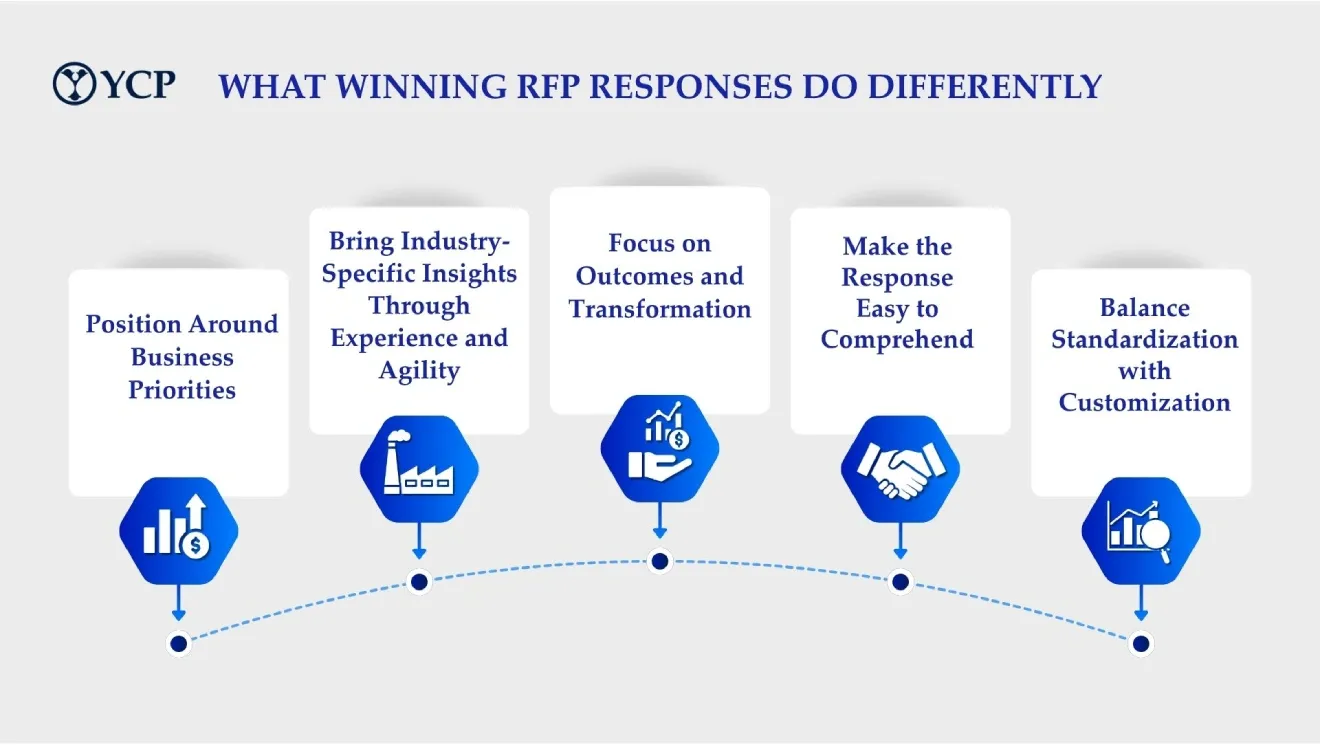
Organizations that consistently create high-impact RFP responses focus on value communication, not just capability documentation.
1. They Position Around Business Priorities
Winning responses align directly with the customer’s strategic objectives.
Instead of explaining everything the solution can do, they focus on what matters most to the client:
Growth
Efficiency
Risk reduction
Compliance
User adoption
Scalability
Innovation
This creates stronger relevance and executive resonance.
2. They Bring Industry-Specific Insights Through Experience and Agility
Strong vendors demonstrate industry understanding through:
Tailored use cases
Industry benchmarks
Relevant customer examples
Operational insights
Regulatory awareness
This builds credibility and positions the vendor as a strategic partner rather than just a technology provider.
3. They Focus on Outcomes and Transformation
Instead of only describing workflows and features, differentiated responses explain:
What changes after implementation
How users benefit
What operational improvements are expected
How business value will be measured
This shifts the discussion from software functionality to transformation impact.
4. They Make the Response Easy to Comprehend
High-quality responses prioritize readability and executive communication.
Effective responses typically include:
Executive summaries
Visual frameworks
Clear differentiators
Value-led messaging
Structured response flow
Minimal redundancy
A well-structured response improves evaluator engagement and retention.
5. They Balance Standardization with Customization
Templates and reusable content are important for efficiency.
However, leading organizations know where customization matters most:
Executive summaries
Industry positioning
Transformation approach
Client-specific challenges
Relevant case studies
Differentiation themes
This creates responses that are both scalable and personalized.
The Shift from Responding to Positioning
The most successful organizations no longer treat RFPs as administrative documents.
Instead, they treat them as strategic positioning tools.
The goal is not simply to answer every question but to help evaluators clearly understand:
Why this vendor
Why this approach
Why this solution
Why this partner
Differentiation happens when vendors move beyond capability descriptions and demonstrate a clear understanding of business outcomes, industry context and transformation value.
Final Thoughts
In increasingly competitive markets, most RFP responses fail because they focus too heavily on compliance and too little on differentiation.
The vendors that stand out are those that communicate relevance, clarity, credibility and measurable value.
As procurement and business stakeholders become more strategic in vendor evaluation, successful RFP responses must evolve from feature-heavy submissions into compelling business narratives.
Because in the end, buyers rarely remember every feature. They remember the vendors that clearly understood their pain points and communicated value effectively.
Get in Touch with Us
Get in touch with us to discuss your strategic needs and how we can help you develop a plan to accelerate your growth
Schedule a ConsultationRelated Articles

Invisible Risk, Visible Impact: How Procurement Can Manage Hidden Vulnerabilities
Industrials
Why Manual S2P Is Dead: The Case for Digital Procurement Transformation
Industrials
Vendor Management Best Practices: How to Maintain Strong Supplier Relationships
Industrials