From Supplier Dependency to Sourcing Strength: A Global Tractor Manufacturer’s Transformation

A global leader in agricultural machinery manufacturing and one of the world’s top five tractor brands operates a large-scale manufacturing and export network serving more than 1.5 million farmers across 150+ countries. With a diverse portfolio spanning tractors from 20HP to 120HP and advanced farming implements, the company depends on a reliable supply base to support manufacturing continuity and customer commitments.
As sourcing requirements expanded across multiple categories, the organization faced constraints in developing a broader and more competitive supplier ecosystem. Niche categories were particularly challenging, with limited technical expertise among vendors and a high degree of dependency on a small number of experienced suppliers.
At the same time, a strong preference for local suppliers limited access to international benchmarks and reduced competitive tension. Vendor participation was further constrained by rigid internal policies that prevented some suppliers from participating in digital e-Auctions, while standardized NET 60 payment terms made participation less attractive for vendors operating in lower-margin categories.
These sourcing constraints were compounded by logistical fragility. Frequent delivery delays and variations in lead times were affecting order fulfillment and, ultimately, customer satisfaction. YCP Supply Chain was engaged to strengthen sourcing competition, broaden the supplier ecosystem and improve the commercial and operational foundations of the supply chain.
The objective was clear: create a more flexible and competitive sourcing model that could deliver measurable savings while improving supplier participation, category coverage and supply chain reliability.
Challenges
The organization’s sourcing environment combined supplier concentration, commercial constraints and logistics challenges that limited both cost competitiveness and supply continuity.
Restricted supplier ecosystem: A lack of experienced vendors and limited technical expertise in niche categories created high dependency on a few capable players.
Localized sourcing bias: A heavy preference for local-market vendors limited competitive tension and reduced access to global pricing benchmarks.
Procedural barriers to digital bidding: Rigid vendor policies often prevented suppliers from participating in digital e-Auctions, forcing procurement towards manual and less transparent sourcing cycles.
Payment-term constraints: Standardized NET 60 payment terms discouraged high-quality vendors from participating in low-margin projects, reducing supplier competition.
Logistical fragility: Frequent delivery delays and lead-time variations were directly affecting order fulfillment and overall customer satisfaction.
The challenge was therefore broader than achieving lower purchase prices. The organization needed to create a sourcing model that could attract the right suppliers, work within different vendor policies, improve commercial attractiveness and strengthen supply continuity.
Approach
YCP Supply Chain adopted a multi-dimensional sourcing strategy combining supplier development, flexible bidding mechanisms, financial incentives and targeted category management.
Expanding the Supplier Ecosystem Through Global Vendor Onboarding
YCP expanded the supply base through global sourcing networks and technical training programs. The objective was to address the experience gap in niche technologies by identifying additional capable suppliers while supporting their ability to meet the organization’s technical requirements.
This approach reduced dependence on a small group of incumbent vendors and introduced a broader pool of suppliers capable of participating in future sourcing initiatives.
Introducing a Hybrid Bidding Framework
Recognizing that not every supplier could participate in a digital e-Auction, YCP deployed a flexible procurement model that integrated e-Auctions with sealed quotations and negotiated bidding.
This hybrid framework allowed procurement to maintain competitive tension without excluding suppliers because of their internal bidding policies. It also created a more practical mechanism for comparing commercial offers across a diverse supplier base.
Improving Supplier Economics Through Payment Flexibility
To make sourcing opportunities more commercially attractive, YCP introduced a tiered payment structure, including NET 30 options and early-payment discounts such as 2% for payment within 15 days.
The revised commercial structure improved supplier cash flow and helped make participation more viable for vendors operating in lower-margin projects, supporting stronger competition without relying solely on price negotiation.
Applying Strategic Category Management
YCP applied targeted sourcing strategies across five core spend pillars: Capex, Transportation, MRO, Scrap and Packaging.
Rather than applying a single sourcing model across all categories, the engagement aligned sourcing mechanisms to category characteristics, supplier availability and commercial dynamics.
Building Operational Resilience Through a Broader Supply Base
The combined sourcing strategy balanced local market participation with specialized international supplier partnerships. This created a more diversified supplier ecosystem and reduced regional sourcing risk while improving access to specialized capabilities.
The approach also supported better inventory visibility and more predictable lead times, addressing the operational consequences of supplier and logistics constraints.
Impact
The strategic sourcing transformation delivered measurable financial value while improving supplier diversity, operational scalability and supply chain reliability.
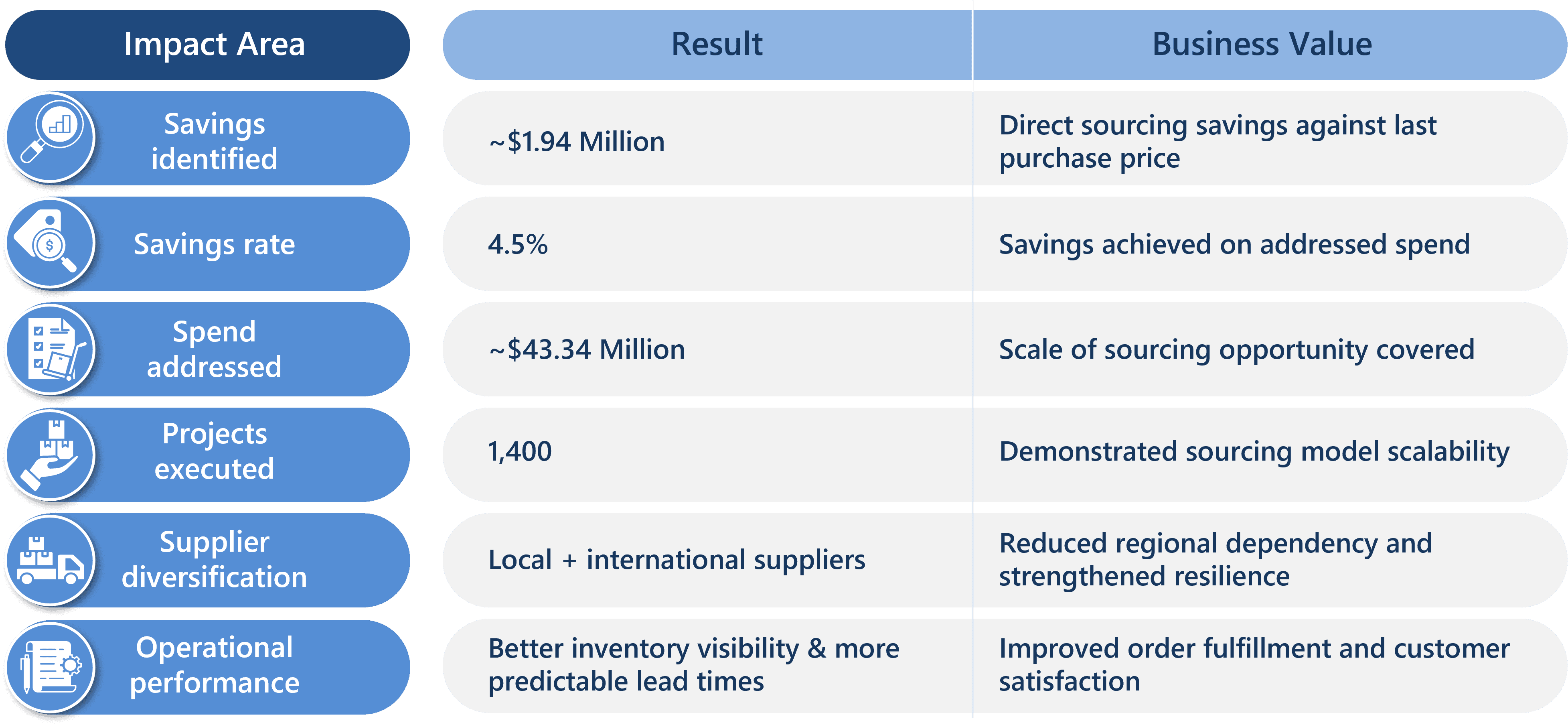
The initiative identified approximately $1.94 million in savings, equivalent to 4.5% of the approximately $43.34 million in addressed spend based on last purchase price.
Beyond savings, the sourcing model demonstrated significant operational scalability, with 1,400 individual projects successfully executed to date. The broader supplier ecosystem also reduced regional risk by balancing local participation with specialized international partnerships.
Operationally, improved inventory visibility and more predictable lead times contributed to stronger order fulfillment and a marked increase in end-customer satisfaction.
Impact at a Glance
Outcome
By moving beyond a locally concentrated and process-constrained sourcing model, the agricultural machinery manufacturer built a more flexible procurement ecosystem capable of engaging a broader range of suppliers.
Global vendor onboarding, a hybrid bidding framework and improved payment structures helped increase supplier participation, while strategic category management enabled differentiated sourcing approaches across Capex, Transportation, MRO, Scrap and Packaging.
The transformation delivered approximately $1.94 million in identified savings, representing 4.5% of addressed spend, while supporting 1,400 individual sourcing projects and strengthening the organization’s supplier and logistics resilience.
The result was a more competitive and scalable sourcing model with broader supplier access, improved inventory visibility, more predictable lead times and stronger end-customer satisfaction.