Beyond Local Supplier Networks: Building Outage Readiness for a Global Power & Water Operator

A global operations and maintenance (O&M) services operator managing gas-turbine power generation and water desalination assets under long-term, availability-based contracts operates across the GCC, Southeast Asia, and Central/South Asia. With a multi-country asset footprint and a heavy reliance on third-party services during planned and emergency outages, the reliability of its supplier base was critical to protecting operational continuity and revenue.
The organization faced a fragmented supplier landscape. Vendor relationships were often managed at the site or country level, while local markets operated under different regulatory frameworks, HSE regimes and vendor pools. For outage-critical categories such as manpower, NDT services, equipment rental, machining workshops and tool containers, the consequences of selecting an unsuitable supplier could extend well beyond procurement performance.
At the same time, increasing client and lender scrutiny was placing greater emphasis on supplier HSE and quality governance, traceability and the defensibility of qualification decisions. The organization therefore needed a consistent, cross-border qualification framework and a vetted supplier pool that could provide back-up capacity across markets.
YCP Supply Chain was engaged to run a dedicated sourcing and qualification exercise, building a defensible shortlist across six categories and ten countries within a fixed four-month window.
Challenges
The scale and criticality of the supplier qualification exercise meant that the organization needed to address both operational risk and governance requirements at the same time.
Fragmented vendor relationships: Supplier relationships were managed across countries and sites without a common qualification bar for outage-critical suppliers.
Critical category coverage gaps: Manpower, NDT services, equipment rental, machining workshops and tool containers required vetted back-up capacity across borders.
Vendor reliability concerns: The organization needed greater confidence in consistent service delivery and adherence to signed technical and commercial terms.
Different country requirements: Ten countries brought distinct local vendor pools, regulatory frameworks and HSE regimes, complicating the creation of a consistent qualification approach.
Rising HSE and quality scrutiny: Clients and lenders were increasingly focused on supplier HSE and quality governance, as well as traceability of qualification decisions.
High operational risk of a wrong call: For outage-critical and quality-sensitive assets, an unvetted or underperforming supplier could contribute to costly downtime.
Compressed decision timeline: The qualification decision had to result in a defensible and auditable shortlist within a fixed window, requiring a dedicated sourcing team working alongside the client.
Approach
YCP Supply Chain structured the engagement around supplier discovery, qualification, technical screening, client validation and onboarding. The process was designed to create a repeatable qualification framework while accounting for the differences between categories and countries.
Aligning Stakeholders and Defining the Qualification Framework
YCP began by engaging stakeholders and collecting the scope, technical specifications and vendor qualification checklist across six sourcing categories and ten countries: UAE, KSA, Oman, Malaysia, Philippines, Thailand, Vietnam, Indonesia, Bangladesh and Uzbekistan.
The qualification framework was anchored in client-defined criteria and a three-section General, Quality and HSE checklist, creating a common screening structure across the diverse supplier markets.
Building a Cross-Border Supplier Long List
YCP conducted desk and network research to build a category- and country-specific candidate long list. The team then issued RFIs to nearly 3,000 suppliers across the GCC, Southeast Asia and Central/South Asia and followed up on responses to maximize supplier participation.
This broad outreach created a significantly wider starting pool from which to identify suppliers capable of supporting outage-critical requirements.
Screening Suppliers Through Technical and HSE/Quality Evaluation
Responsive suppliers were taken through technical discussion rounds against the General, Quality and HSE checklist. RFI responses were triaged into outcome states and analyzed at the item level to assess the extent of each vendor’s offering.
Where requested by the client, supplementary interviews provided an additional screening layer before final reporting.
Creating a Defensible Shortlist
Based on checklist results, technical discussions and supplier responses, YCP shortlisted 220 suppliers. Category- and country-level outcome reports were compiled for client review, providing a structured basis for validation and final selection.
The final outcomes were discussed with the client, with online meetings held with suppliers for final validation before onboarding.
Client Validation and Supplier Onboarding
The client’s engineering team retained final responsibility for validating shortlisted suppliers against site-specific requirements. Once approved, suppliers were onboarded into the client’s vendor system.
This converted the qualified supplier base into an active bidder pool for future purchase requisitions and purchase orders, as well as future RFQs and e-auctions.
Impact
The engagement created a significantly broader and more standardized supplier base for outage-critical services while strengthening the governance behind supplier qualification decisions.
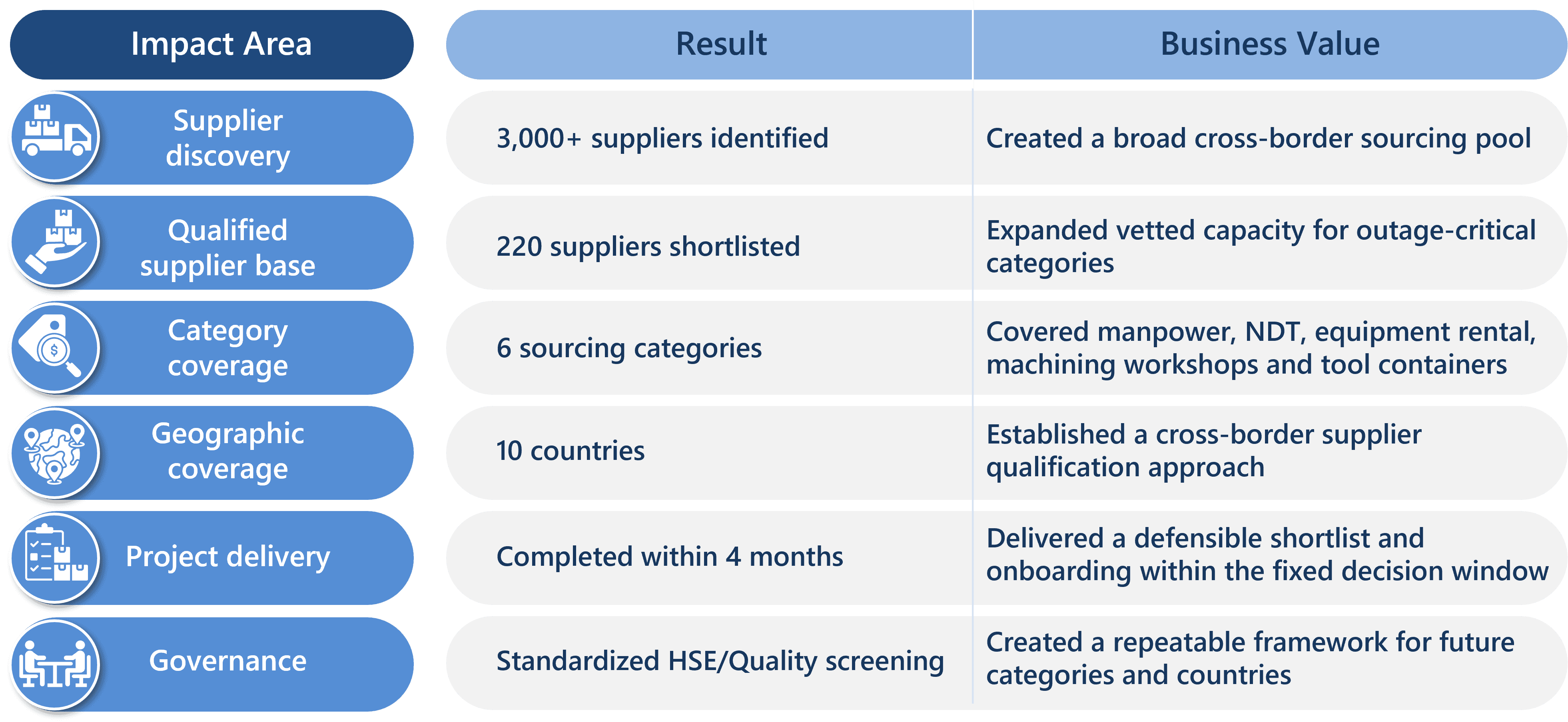
From a long list of more than 3,000 suppliers, 220 suppliers were shortlisted across six categories and ten countries. The full project was completed within four months from kickoff, including supplier onboarding into the client’s system.
Most importantly, the qualification framework established a consistent HSE and Quality screening approach across the GCC, Southeast Asia and Central/South Asia. This created a repeatable foundation that can be applied to additional categories and countries.
Impact at a Glance
Outcome
By moving from fragmented, site-level supplier relationships to a structured cross-border qualification process, the O&M operator strengthened the depth and consistency of its supplier base for outage-critical services.
The exercise produced 220 shortlisted suppliers from a 3,000-plus supplier universe across six categories and ten countries, with client validation and system onboarding completed within four months.
The standardized HSE and Quality screening framework also created a repeatable governance model for future supplier qualification exercises, helping the organization build a more reliable and defensible supplier ecosystem across its multi-country operations.