Unlocking 7.54% in Ocean Freight Savings: How a Global Industrial Manufacturer Put Carrier Competition to Work

A leading global manufacturer of synthetic graphite electrodes, specialized carbon products and composite equipment serves demanding industrial customers across steelmaking, smelting and heavy engineering. With products moving across international trade lanes, ocean freight was a critical component of its supply chain and a significant source of cost exposure.
The organization was operating in a global ocean freight environment characterized by rapidly changing shipping rates, port congestion, fuel surcharges and geopolitical disruption. At the same time, foreign exchange movements added another layer of uncertainty because freight commitments were managed in USD terms.
As the company evaluated freight across multiple trade lanes, differences in carrier pricing structures and the complexity of surcharges made conventional email-based negotiations increasingly difficult to manage. YCP Supply Chain was engaged to bring greater transparency to freight bidding, strengthen carrier competition and identify measurable cost savings.
The objective was clear: create a standardized, transparent and competitive freight sourcing process that could improve price discovery while supporting reliable global logistics execution.
Challenges
The global container freight environment presented a combination of market volatility, pricing complexity and limited competitive transparency.
Global ocean freight volatility: Rapid changes driven by port congestion, fuel surcharges and geopolitical dynamics made long-term freight budgeting difficult.
Currency exposure: Spot freight rates and foreign exchange fluctuations created additional cost unpredictability for global export shipments.
Complex multi-lane pricing: Freight bids included Base Freight, BAF, CAF and Terminal Handling Charges, making manual comparison across routes time-consuming and error-prone.
Unstandardized pricing structures: Different approaches to freight and surcharge pricing created limited comparability and increased the risk of hidden destination costs.
Limited carrier competition: Traditional email-based negotiations restricted real-time price discovery among shipping lines and NVOCCs.
Weak market-rate visibility: Limited visibility into market-clearing rates reduced negotiation leverage and constrained access to a broader pool of global logistics providers.
The combination of volatile rates and fragmented bidding structures meant that procurement needed more than a conventional RFQ exercise. The sourcing process had to create apples-to-apples comparisons, enable genuine competition and provide a disciplined mechanism for locking in commercially attractive freight rates.
Approach
YCP Supply Chain implemented a structured reverse-auction process built around standardized lane definitions, transparent rate matrices, prequalified carriers and real-time competitive bidding.
Standardizing Trade Lane & Container Bidding
YCP created structured multi-lane bidding templates covering standard container sizes including 20ft, 40ft and 40ft High Cube containers, along with defined payload weight categories of 21 MT and 22 MT.
Base ocean freight was separated from mandatory surcharges such as BAF, CAF and THC and incorporated into a standardized USD rate matrix. This created an apples-to-apples basis for comparing carrier proposals across different trade routes.
Expanding and Qualifying the Carrier Pool
Leading global shipping lines, freight forwarders and NVOCCs were prequalified and onboarded onto the centralized e-procurement portal. Comprehensive bidding guidelines ensured that participating providers understood the required rate structure, container specifications, weight categories and bidding process before the auction began.
Executing Dynamic Reverse Auctions
YCP conducted live reverse auctions with real-time USD price bidding at the container and weight-class level across major export and import trade lanes.
Auto-extension mechanisms were used to keep the bidding competitive when suppliers submitted bids close to the auction deadline. This encouraged continued participation and helped push rates towards their true market minimums.
Using Real-Time Data to Lock in Competitive Rates
During the auctions, YCP monitored bidding activity and supplier positions in real time. Post-auction comparative reports identified the top-ranked carriers on each trade lane, including L1 and L2 positions.
These outputs accelerated internal evaluation and approvals, enabling the organization to allocate freight volumes and move towards long-term, volume-based freight contracts with competitive carriers.
Creating a More Transparent Freight Sourcing Model
By bringing standardized pricing, multiple logistics providers and live bidding into one centralized process, the engagement replaced fragmented email-based negotiations with a more disciplined and transparent freight sourcing model.
The approach gave procurement a clearer view of competitive market rates while creating stronger commercial leverage across participating carriers and logistics providers.
Impact
The freight sourcing initiative delivered measurable cost savings while improving transparency and competitive tension across the logistics procurement process.
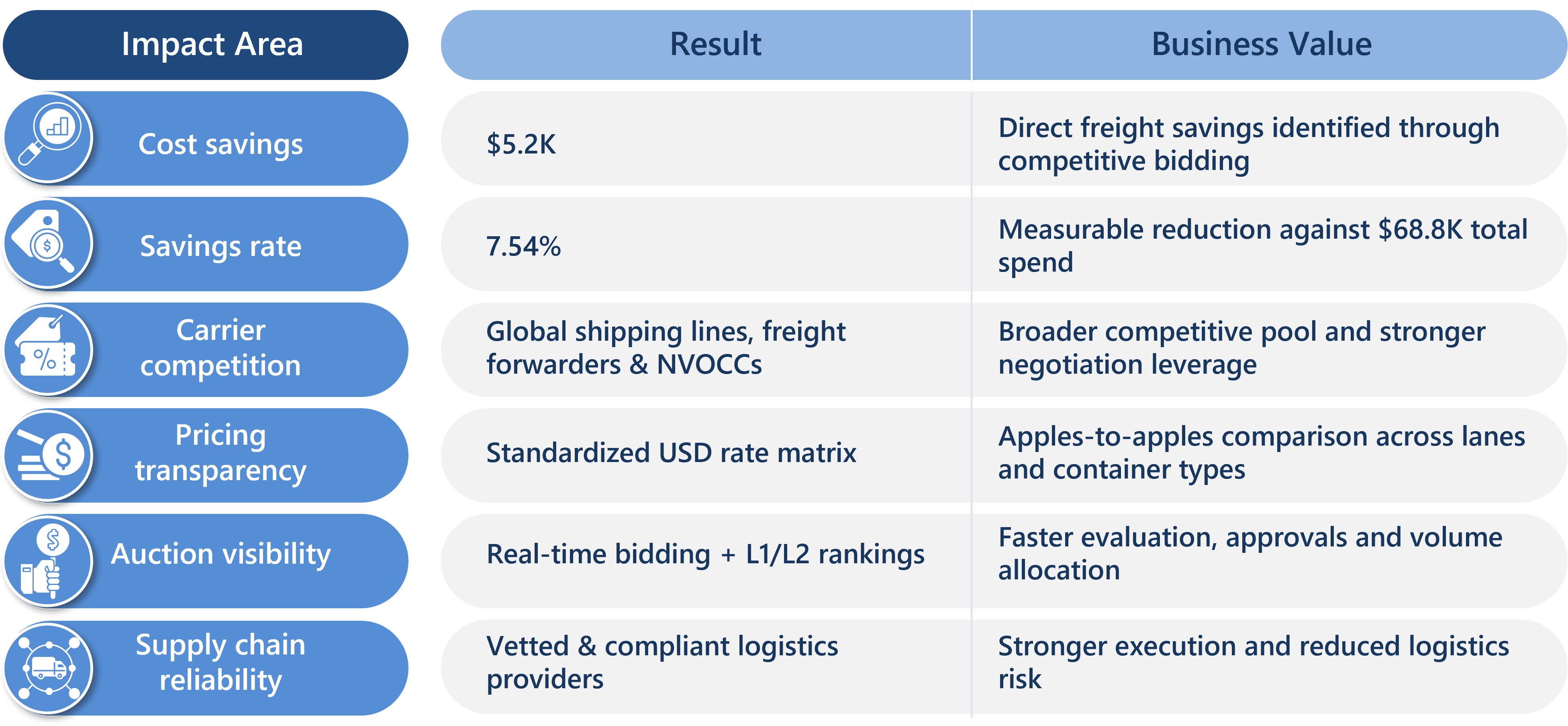
The engagement identified $5.2K in savings against a total spend of $68.8K, representing a 7.54% cost saving. The result demonstrated the value of structured competitive bidding even within a volatile global freight market.
Beyond the direct savings, the process strengthened supply chain reliability through engagement with vetted and compliant logistics service providers and improved operational efficiency through transparent H1 reporting and disciplined execution.
Impact at a Glance
Outcome
By replacing fragmented freight negotiations with a structured reverse-auction model, the manufacturer gained greater control over one of its most volatile logistics cost categories.
Standardized bidding templates, transparent surcharge structures and real-time competitive bidding created a stronger basis for price discovery and carrier selection across global trade lanes.
The initiative delivered $5.2K in identified savings, equivalent to 7.54% of total spend, while improving transparency, strengthening carrier competition and supporting more disciplined freight contracting.
The result was a more structured freight sourcing model that enabled the organization to navigate volatile ocean freight markets with greater commercial visibility and stronger execution discipline.