How a Leading Waste Management Company Unlocked $32.2M Spend Visibility with Advanced Analytics

A leading North American waste management company was facing a problem common in large procurement ecosystems: millions in spend data existed, but very little visibility into what was actually being purchased, from whom and at what price. With over 13 million customers, 17,000 trucks and operations spread across more than 1,000 locations, procurement decisions were becoming increasingly difficult to standardize. What appeared to be a simple spend visibility issue soon revealed deeper inefficiencies hidden across thousands of SKUs, fragmented vendor records and inconsistent purchasing patterns. To solve this, the organization partnered with us to bring structure, transparency and intelligence into its procurement operations through BluMor’s ML-powered spend analytics platform.
Challenges
Despite managing $32.2M in annual spend across indirect and direct procurement categories, the organization lacked a unified procurement intelligence framework.
Key issues included:
No standardized spend classification across categories such as HVAC, Landscaping, Janitorial, Hazmat and Parts & Maintenance.
12,912 SKUs were not classified under any globally accepted taxonomy such as UNSPSC.
Procurement teams lacked SKU-level visibility, making rationalization and supplier negotiations difficult.
Leadership relied on fragmented reports, resulting in delayed and inefficient decision-making.
Multiple similar products were being sourced with slight variations in size, scent, or color at inconsistent prices.
Tail-end supplier fragmentation reduced negotiation leverage and increased procurement complexity.
The absence of a centralized analytics system meant the business could not identify redundancies, benchmark pricing, or uncover sourcing opportunities at scale.
Approach
To address the issue, the team implemented BluMor, YCP Supply Chain’s proprietary ML-powered spend analytics engine.
The transformation focused on four strategic initiatives:
Consolidated 24 months of procurement data into a unified analytics-ready dataset.
Classified 100% of spend across 12,912 SKUs and 1,864 suppliers using the globally accepted UNSPSC taxonomy.
Built category-level visibility across both indirect and direct procurement functions.
Conducted SKU and supplier rationalization analysis to identify standardization opportunities.
The analytics uncovered several hidden inefficiencies. For instance, identical cleaning products with different fragrances were being purchased from multiple vendors at varying price points. Similarly, trash bags with minor size or color differences were sourced inconsistently, even from the same supplier.
These insights enabled procurement leaders to move beyond reactive purchasing and toward strategic sourcing decisions backed by real data.
Impact
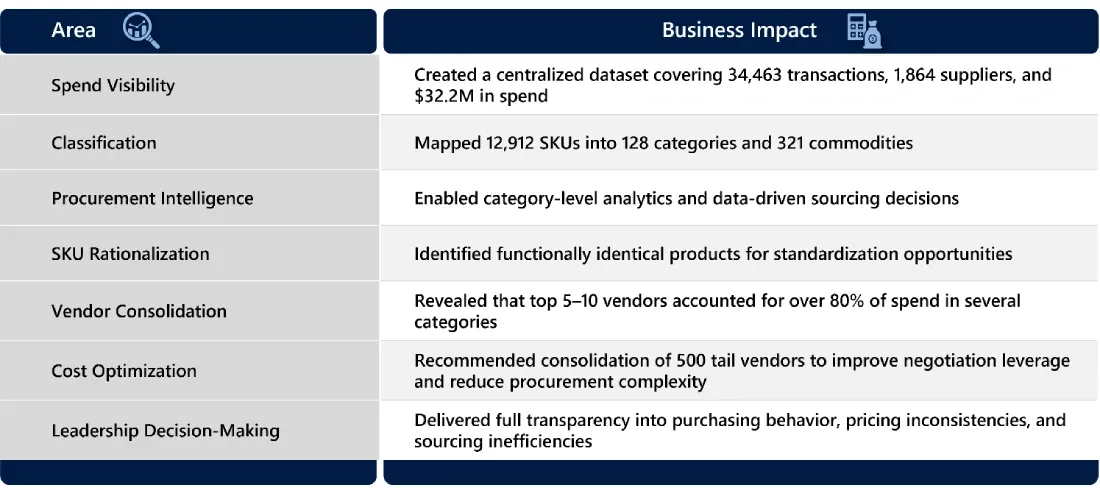 Beyond operational improvements, the project fundamentally changed how procurement decisions were made. Leadership teams could now identify patterns instantly, benchmark supplier performance and prioritize sourcing strategies based on actionable insights instead of fragmented reports.
Outcome
With end-to-end spend visibility, structured SKU classification and actionable procurement intelligence, the client transformed fragmented procurement operations into a streamlined, data-driven sourcing ecosystem built for long-term cost optimization and strategic growth.