How a Middle East Airline Digitized S2C Ecosystem

As global aviation rebounded after COVID-19, a leading Middle Eastern airline found itself navigating a perfect storm of rising supply costs, aircraft delivery delays and mounting operational pressure. Procurement teams were stretched thin, managing sourcing activities through scattered emails, offline approvals and manual contract extensions. What once worked at a smaller scale had become a bottleneck for a growing airline connecting the Middle East with Asia, Europe and Africa. To keep pace with expansion while improving governance and operational agility, the organization embarked on a large-scale procurement digitization journey.
Challenges
The airline’s procurement ecosystem had evolved organically over the years, creating inefficiencies that slowed decision-making and increased operational risk.
Key challenges included:
Fragmented procurement processes with heavy dependence on email-based coordination
Manual supplier onboarding and sourcing workflows causing delays and process inconsistencies
Frequent offline contract extensions due to supply disruptions and aircraft delivery delays
Limited supplier visibility leading to supplier dependency and weaker negotiation leverage
Lack of centralized procurement data, making reporting and tracking difficult
Excessive manual follow-ups across sourcing, approvals and contracting cycles
Weak governance controls impacting compliance and process transparency
As procurement volumes increased, the absence of a connected digital ecosystem became more evident. Leadership recognized the need for a scalable Source-to-Contract (S2C) platform that could improve visibility, automate workflows and strengthen procurement governance across the enterprise.
Approach
The transformation began with defining clear priorities aligned to the airline’s operational and strategic goals.
Defining the Transformation Priorities
The procurement digitization roadmap focused on:
Enabling seamless and transparent supplier onboarding
Reducing manual effort across sourcing and approvals
Automating workflows with embedded compliance controls
Improving procurement visibility through centralized data management
Enhancing supplier collaboration and sourcing efficiency
Creating a scalable procurement operating model for future growth
Implementing an End-to-End S2C Platform
To bring the vision to life, the organization implemented a centralized Source-to-Contract platform with integrated digital capabilities.
The solution included:
Automated workflows, approvals and notifications
Centralized supplier and contract repositories
Multi-round bidding and supplier collaboration tools
E-auction capabilities for improved price discovery
Real-time dashboards and reporting for procurement visibility
Standardized award and contract workflows with embedded compliance controls
The transformation was not just about technology implementation—it was about redesigning procurement operations to become faster, more transparent and data-driven.
Impact
The digitization initiative delivered measurable operational and governance improvements across the procurement lifecycle.
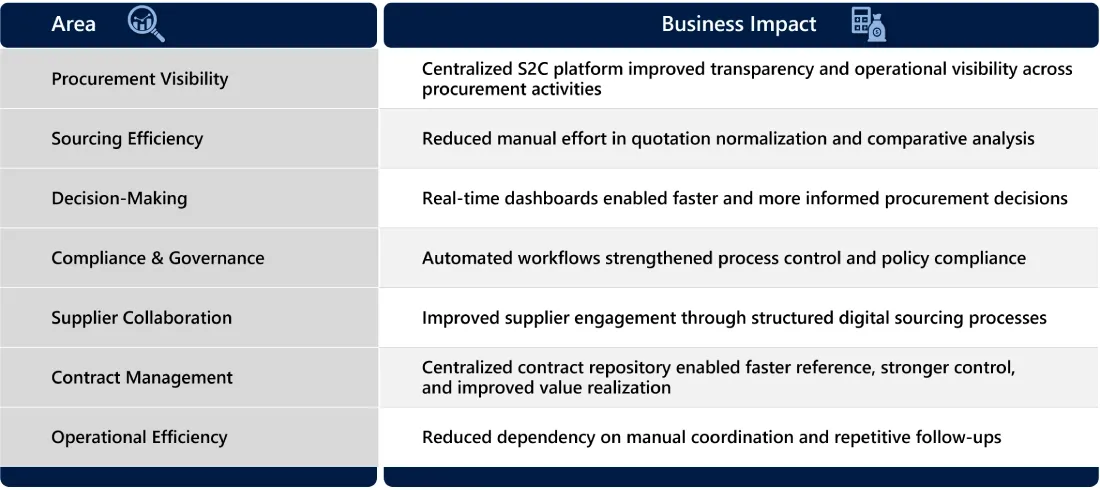
The transformation positioned procurement as a more agile and strategic function capable of supporting the airline’s long-term operational growth.
Outcome
By digitizing its procurement ecosystem, the airline successfully transformed procurement from a fragmented, manual function into a centralized, transparent and scalable S2C operation built for resilience and future growth.