From Duplicate Codes to Clear Priorities: Transforming Material Master Management in Offshore Drilling

A leading offshore drilling company operating ultra-deepwater and harsh-environment drillships faced a growing material master challenge across three rigs. Material codes had continued to expand after the original system setup, while a Maximo migration added approximately 30,000 inactive codes overnight. The result was a fragmented material environment with limited cross-rig standardization, persistent duplicate creation and increasing exposure to working-capital lock-up.
YCP Supply Chain used its proprietary AI engine, BluMor, to analyze and cleanse the material master across the three rigs. By combining material master analytics with AI-powered duplicate detection and a structured cleanup roadmap, the engagement helped the client quantify duplicate exposure, identify the materials with the highest operational and financial impact, and establish a phased path toward a more standardized active master.
Challenges
Unchecked Material Code Creation: Material master growth across all three rigs, including quarterly spikes, indicated repeated loading and weak reuse of existing codes.
Low Cross-Rig Standardization: Only 3% of active codes were shared across all three rigs, while 78% were unique to one rig, creating three largely independent material environments.
Persistent Duplicate Creation: Duplicate codes continued to be created beyond migrations, with more than 41,000 duplicate codes identified across the active master.
Working Capital Locked in Duplicates: Approximately 25% of active duplicate codes held on-hand stock, with $13.7 million, representing 71% of $19.35 million in inventory, tied to non-moving duplicate materials.
No Structured Cleanup Prioritization: The client lacked a methodology to sequence cleanup and distinguish immediate priorities from mid- and long-term remediation.
Operational Disruption from Active Duplicates: Although 89% of duplicates had no issuance history, the active 11% disrupted operations; 51% fell into fast/medium issuance bands and 16% of issuance was linked to duplicate-coded materials.
Approach
Material Master Analytics Across Three Rigs
YCP Supply Chain deployed BluMor to cleanse and analyze the material master across all three rigs, covering approximately 375,000 transactions and 194,000 active material codes. The analysis identified approximately 41,000 duplicate codes, creating a data-driven baseline for remediation.
AI-Powered Duplicate Detection
BluMor applied NLP normalization, TF-IDF vectorization and K-Means clustering to group potentially duplicate materials into confidence tiers. This enabled duplicate identification using manufacturer information, manufacturer part numbers (MPNs) and material descriptions.
Inventory and Procurement Exposure Analysis
The analysis connected duplicate materials to inventory and procurement exposure, surfacing $19.35 million in inventory tied to duplicate codes, including $13.7 million in non-moving materials. It also identified $7.04 million in procurement over two years linked to duplicate materials.
Staged Duplicate Cleanup Prioritization
Rather than treating every duplicate as an immediate remediation item, YCP Supply Chain structured cleanup across three horizons. Prioritization considered issuance activity and stock exposure to focus first on materials with the greatest operational impact.
Client Validation and Cleanup Roadmap
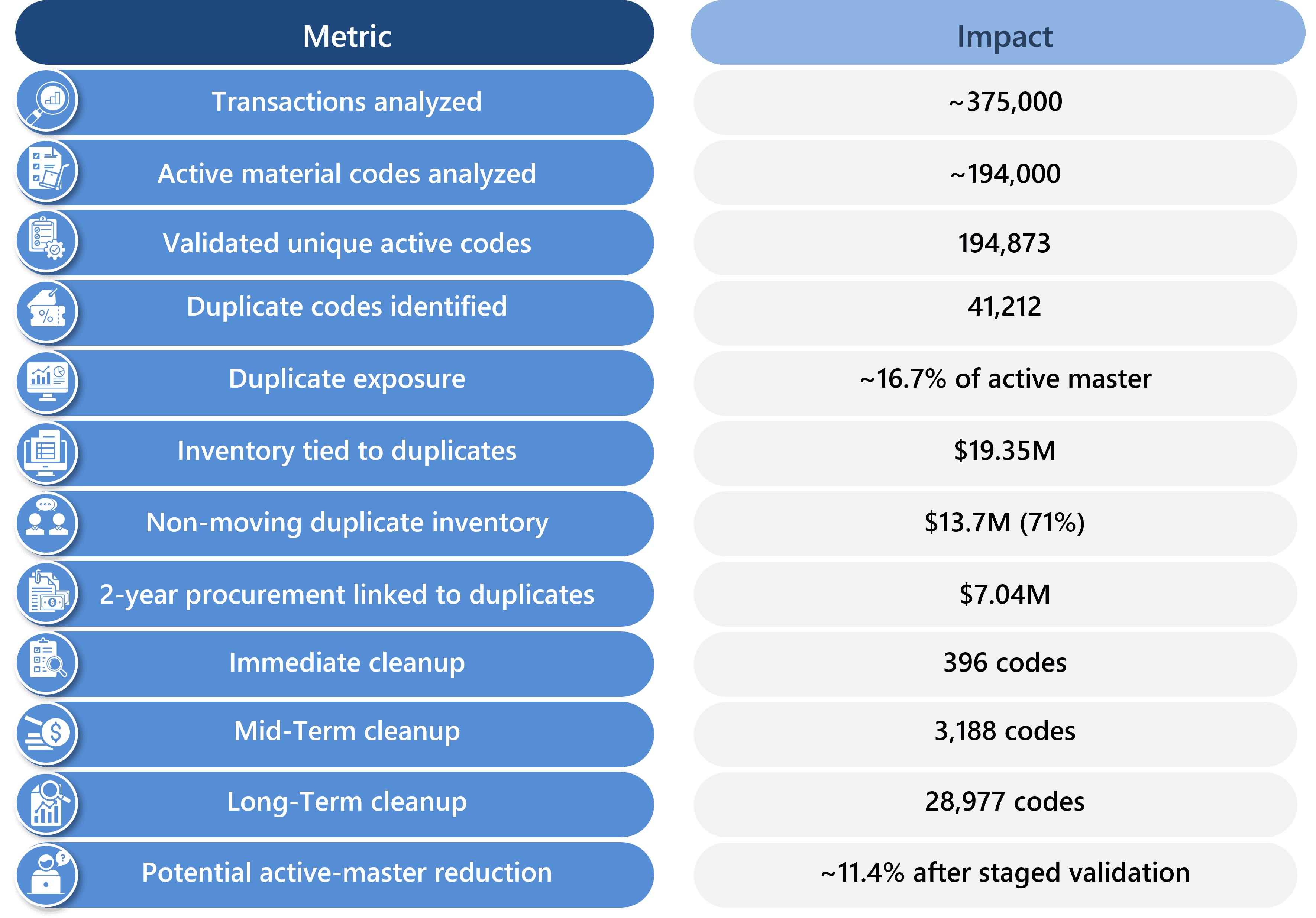
YCP Supply Chain presented rig-level trends, cross-rig commonality, confidence tiers and the phased roadmap in a client validation workshop. The resulting roadmap identified 396 Immediate, 3,188 Mid-Term and 28,977 Long-Term codes for staged remediation.
Impact
The engagement gave the client a validated view of material master quality across its three rigs, quantified the financial exposure associated with duplicate materials and established a practical sequence for remediation. The analysis covered approximately 375,000 material transactions and produced a validated active master of approximately 194,873 unique active codes.
The work identified approximately 41,212 duplicate codes, representing about 16.7% of the active master. More importantly, it linked duplicate exposure to operational activity, inventory and procurement, enabling the client to distinguish high-priority cleanup from longer-term remediation. A potential active-master reduction of approximately 11.4% was identified after staged validation.
Impact at a Glance
Outcome
The engagement moved the client from fragmented material-code management to a structured, evidence-based cleanup program. By combining AI-powered duplicate detection with inventory and procurement exposure analysis, YCP Supply Chain helped the client identify where duplicate materials were creating the greatest operational and working-capital impact.
With a three-horizon remediation roadmap and client-validated priorities, the organization gained a clearer path to reducing duplicate exposure, improving cross-rig material standardization and strengthening the governance of its material master over time.
Source: YCP Supply Chain case study, “Material Master Cleanup & Deduplication.”